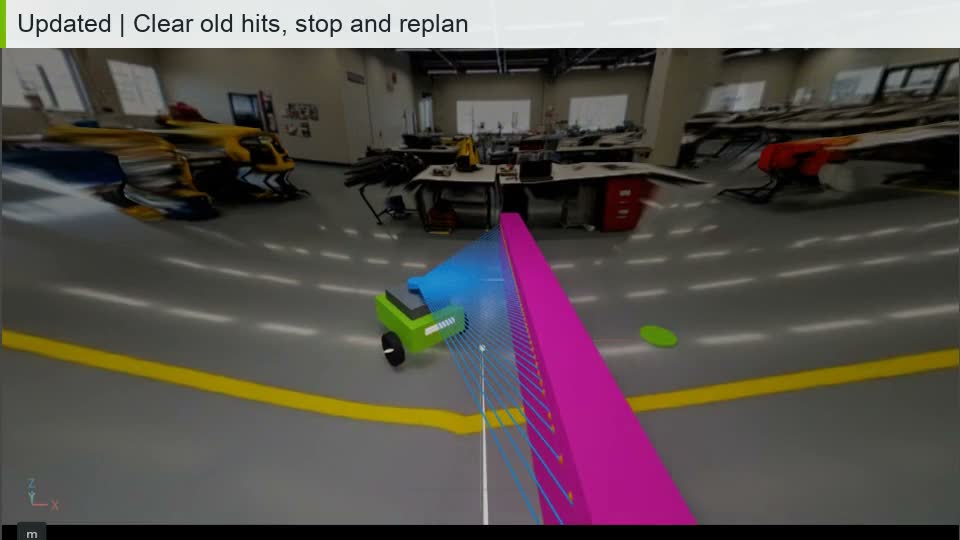
Why a live sensor also needs an up-to-date map
- InputRead a timestamped observation
ranges[180] + hit positions[180,3] + sensor timeThe controller sees measurements and ego pose. The actuator schedule stays outside the planner.
- ProcessRefresh the map and check motion
clear visible space → expire old hits → A* → stop supervisorA passage can reopen. Missing data or an unavailable route stops the wheel commands.
- OutputReplan and physically move again
new path → wheel drives → next measured poseVerify a stationary hold, a changed detour, and matching collider/display positions in the actual run.
The previous controller could add new range hits to its obstacle map, but never removed them. A moving barrier can leave a wall of old observations behind it. Even after the physical route opens, A* may still see an impassable wall.
This lab keeps the actual Isaac Sim 6.2 Physics Raycast Sensor and wheel-driven AMR. It updates map cells from fresh observations, stops when necessary, and replans when a passage changes. The robot receives no obstacle position or motion schedule.
1. Distinguish a current hit from an old memory
The input is still 180 horizontal ranges, measured to 2.5 m, read at 10 Hz. A stored cell now has a location and a time:
ranges:       float[180]       current distances in metres
hit_positions: float[180,3]   world-space endpoints for rays that hit
sensor_time:  float           simulation time of that measurement
observed[(i,j)] = (x, y, last_seen_time)
For each old surface point, the controller finds its direction from the sensor and the nearest current beam. If the new beam extends at least 10 cm farther than the old point, the old surface is no longer blocking that ray and its cell can be cleared. Fresh hits from the current frame take precedence.
A miss returns range 2.5, but the SDK's corresponding hit_position is [0,0,0]. That zero vector is not a measured obstacle at the world origin. Clearing compares the old point with the measured range in the correct direction, rather than using this placeholder as an endpoint.
Observations not refreshed for 2 seconds also expire when a new valid frame is processed. Expiry is a bounded-memory choice for this small experiment; it does not prove an occluded area is free. Unknown cells inside the known test floor remain optimistically traversable. The robot stops if measurements themselves become stale.
2. Separate planning, braking and waiting
A fresh map is inflated and passed to A*. The planner adds a small continuity cost for leaving the previous sensor-generated route, avoiding unnecessary left/right flips from grid changes. This prior route is calculated during the run, not supplied beforehand. A newly blocked passage still forces a different route.
The supervisor then decides what motion is permitted:
| Condition | Command |
|---|---|
| Measurement age exceeds 0.25 s | Stop both wheels |
| Nearest measured surface is below 0.39 m | Stop both wheels |
| A front obstacle crosses the 0.75 m threshold | Brake for 0.6 s |
| No traversable route exists | Wait with zero forward and angular commands |
| A route exists but front range is below 0.58 m | Turn without forward motion |
| A fresh, clear route exists | Follow the new route |
The front sector spans ±25°. The braking trigger rearms after front clearance exceeds 0.95 m. These are chosen settings for this robot and controlled scene, not certified stopping-distance guarantees.
3. Account for the robot's actual rotation center
The driven wheel axle is 0.10 m ahead of the chassis center. Turning in place around that axle moves the chassis center slightly. The new controller therefore follows the axle midpoint, with a 0.52 m inflated radius covering its approximately 0.425 m axle-centered footprint and tracking margin. The older controller uses its original chassis reference and 0.43 m inflation.
The physical destination is still chassis XY [1.3,0]. The new controller approaches axle XY [1.4,0], then aligns the heading with +X. It uses an 8 cm terminal axle tolerance and a 0.08 rad heading tolerance. A single current start cell may be cleared from an inflated margin to permit leaving a quantized boundary; actual measured occupied cells remain blocked.
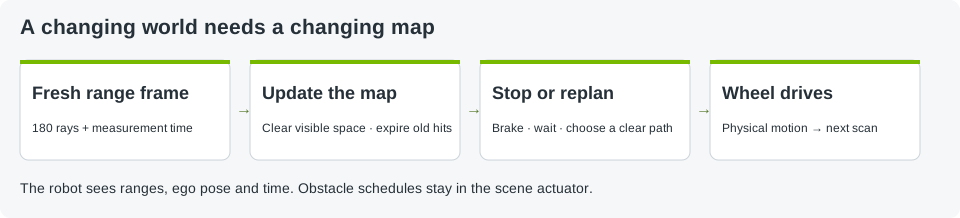
range frame + measured ego pose + measurement time
  → clear/refresh/expire observed cells
  → inflate footprint → A* with route continuity
  → stop / wait / turn / follow / align
  → wheel angular drives → actual PhysX pose → next scan
4. How are the obstacles moved?
The magenta body is a kinematic PhysX rigid body. actors.py supplies continuous targets through set_kinematic_targets() every physics step. The range sensor sees the resulting collider, and recorded poses confirm the actual body follows those targets. Robot motion comes from its wheel drives, not direct chassis pose edits. Orange dots visualize the controller's remembered cells; cyan is the current planned axle path.
The displayed obstacle mesh is synchronized from the measured PhysX pose after every step, using a separate non-colliding visual prim for the 6.2 compatibility renderer. It does not follow a prerecorded animation or merely draw the requested target. render_position_xyz is compared with the actual collider pose in the checker. An empty plan is hidden so an old cyan line cannot remain visible while the robot waits.
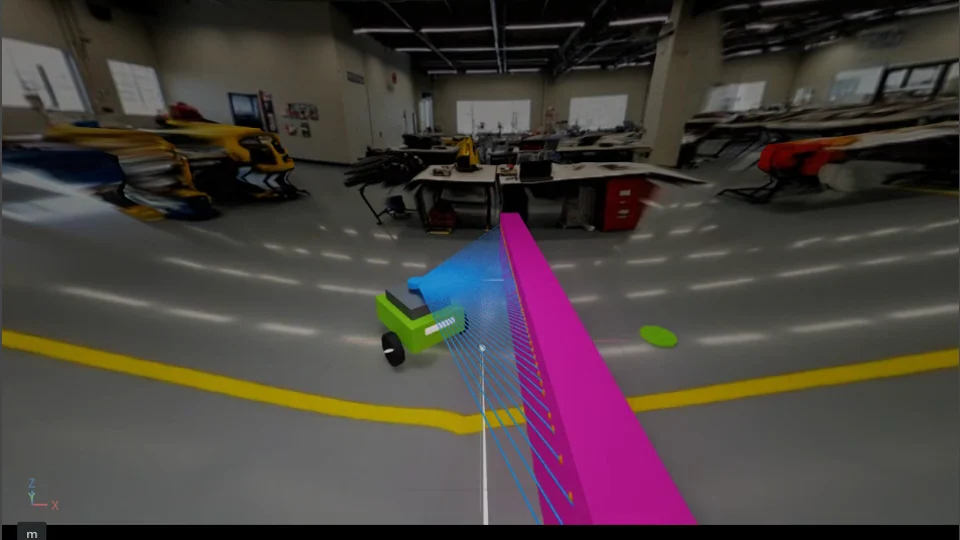
The scene actuator knows its schedule; navigation.py does not import it or receive actor transforms. NVIDIA physics tensor API · Physics Raycast Sensor
First time? Get the lab files
Open a terminal on the Isaac Sim machine for GPU labs, or on your own computer for CPU-only steps. Press Enter after each line. You can copy a multi-line command block as a whole.
cd "$HOME"
git clone https://github.com/james-joobs/awesome-nvidia-physical-ai.git
cd awesome-nvidia-physical-ai
pwd
This example clones into your home folder. If you already cloned the repo, skip git clone and enter your project folder. In each new terminal, check that pwd ends in awesome-nvidia-physical-ai so commands can find the labs/ files.
Run a closing gate and a moving route blocker
1. Prepare the same laboratory
Use a compatible NVIDIA Linux workstation with Docker GPU support. Start with Linux onboarding and the WorldGen import checks if needed. In the repository root:
nvidia-smi
mkdir -p runs/worldgen-dynamic
cp -R labs/worldgen-isaac/assets runs/worldgen-dynamic/assets
export WORLDGEN_DATA_ROOT="$PWD/runs/worldgen-dynamic"
The prepared room needs no new FLUX download. Accept the NVIDIA Omniverse agreement before declaring your own acceptance:
export ACCEPT_EULA=Y
bash labs/worldgen-dynamic-navigation/run.sh gate --controller dynamic
The gate slides into the passage from 2–3.8 s, remains closed, then withdraws from 8–9.8 s. Its programmed maximum speed is 1.5 m/s. Watch the robot brake, wait and resume as sensor observations clear the map. Outputs appear in runs/worldgen-dynamic/gate/.
2. Repeat with the previous permanent-map controller
bash labs/worldgen-dynamic-navigation/run.sh gate --controller static \
  --output /work/gate-static --max-seconds 18
static_navigation.py preserves the previous controller. The start, physical goal, sensor, robot, moving obstacle, motion schedule and 0.32 m/s maximum speed are shared. Its map keeps observations permanently; its control reference and margin retain their old settings. Compare the map dots and the robot after the gate opens.
/work maps to WORLDGEN_DATA_ROOT inside the container. Use separate output folders to keep each attempt.
3. Put a moving box into the route already being followed
bash labs/worldgen-dynamic-navigation/run.sh cart --controller dynamic \
  --output /work/cart-dynamic --max-seconds 38
A central static crate first creates a detour. A second 0.6 m box moves from Y=-2.7 to Y=-0.95 between 2 and 4 s, then remains in the lower passage. Its speed is 0.875 m/s. Check that the first plan used the lower side, and that a later scan changes the plan when this side becomes obstructed. No detour coordinates are supplied to the robot.
4. Interrupt the range stream while driving
bash labs/worldgen-dynamic-navigation/run.sh gate --controller dynamic \
  --dropout-start 1 --dropout-seconds 1 \
  --output /work/sensor-gap
This test harness withholds range frames for one simulation second. The controller only sees the age of its last measurement. It should stop, receive fresh data and continue. Clearing old map cells is never a reason to continue without fresh sensor input.
5. Record the actual simulator window
On an X11 desktop with xwininfo and ffmpeg's x11grab input:
mkdir -p runs/worldgen-dynamic-film
cp -R labs/worldgen-isaac/assets runs/worldgen-dynamic-film/assets
python3 labs/worldgen-dynamic-navigation/record_gui.py \
  --work "$PWD/runs/worldgen-dynamic-film" --scenario gate \
  --controller dynamic --max-seconds 32 --ffmpeg /path/to/ffmpeg
Use a fresh folder for each recording. The helper waits for the real viewport before starting control. Raw native-window video, scans.json, result.json, logs and an initial scene.usdc remain together. Opening the USD lets you inspect the setup; the Python script runs both the robot controller and moving-body actuator.
Check measured stops, replanning and video evidence
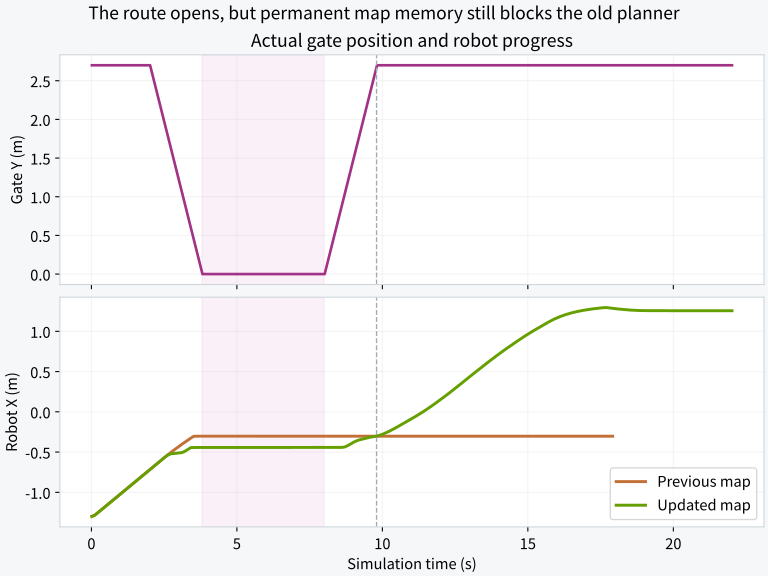
The new controller maintained a measured stationary hold in the 4.0–7.5 s check interval. It generated a new path at 8.6 s as the lower part of the passage reopened. The previous controller still had no path after the gate fully withdrew at 9.8 s. Replaying its final scan into a fresh copy of that same planner does find a route: accumulated memory is the blocker.
| Run | Goal | Time to goal (simulation s) | Obstacle contact reports |
|---|---|---|---|
| Previous permanent map, gate | No | — (18 s test) | 0 |
| Updated map, gate | Yes | 20.07 | 0 |
| Updated map, entering box | Yes | 25.32 | 0 |
| Updated map, 1 s sensor gap | Yes | 20.65 | 0 |
These are individual recorded runs. Goal times exclude the following 2 s hold. All checks also compare actual collider and display coordinates; the recorded difference was zero.
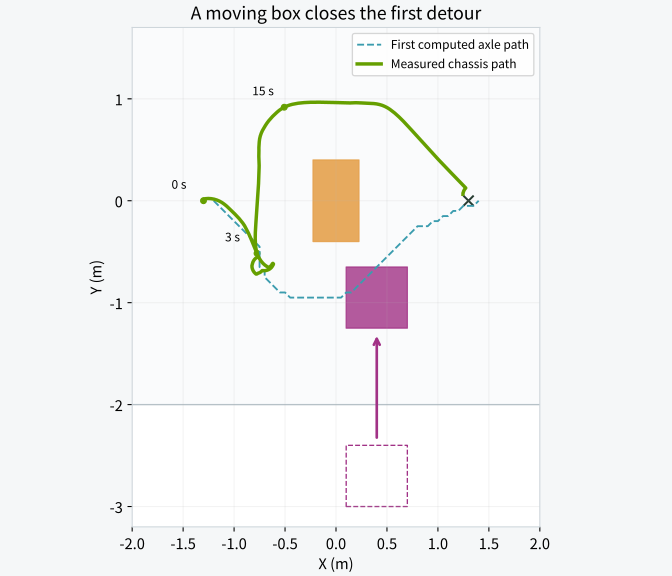
The dashed line is the first sensor-generated axle plan. The solid line is measured chassis motion. The first upper-side plan appeared at 3.1 s, after the box began entering at 2 s. Braking occurred at 4.3 s; a later route took the robot around the other side.
The gate scan below cleared one cell but still had no route. A later frame found a route and permitted combined forward and turning commands. Clearing a cell alone does not release the robot.
[
  {
    "scan_time_s": 8.1,
    "cleared_cells": 1,
    "path_points": 0,
    "phase": "wait-for-path",
    "command_v_omega": [
      0.0,
      0.0
    ]
  },
  {
    "scan_time_s": 8.6,
    "cleared_cells": 2,
    "path_points": 66,
    "phase": "follow-scan-path",
    "command_v_omega": [
      0.2811,
      -1.1
    ]
  }
]
Recorded observation example · Initial USD scenes
python3 labs/worldgen-dynamic-navigation/test_navigation.py
python3 labs/worldgen-dynamic-navigation/check.py
The CPU-only checker verifies actual actor movement, range timestamps, physical standstill, map clearing, route changes, target arrival, obstacle contacts and published media hashes. To inspect your own run:
python3 labs/worldgen-dynamic-navigation/check.py --run runs/worldgen-dynamic/cart-dynamic
The comparison uses native Isaac Sim GUI recordings at 1× speed. The previous-method excerpt and new-method run are labeled separately. Full individual takes remain below the guide.
The ego pose and 5×4 m test-floor boundary are known. Sensing is an ideal horizontal plane, and the generated furniture still has no validated collision coverage. This controller does not estimate obstacle velocity, predict arbitrary human motion, perform SLAM or establish real-robot safety. Nav2 obstacle-layer marking and clearing is useful further reading; Nav2 is not the runtime used here.
Previous sensor lab · Scale and colliders · Media provenance
Example run and recording
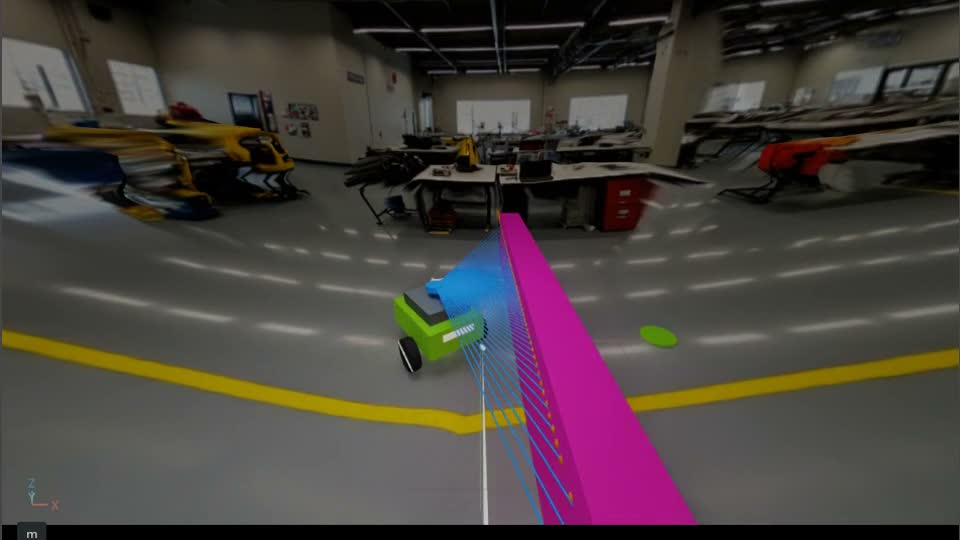
Stop for a closing gate, then continue
A moving physical collider blocks the passage. The robot waits with zero wheel commands and resumes from new observations when a path opens.
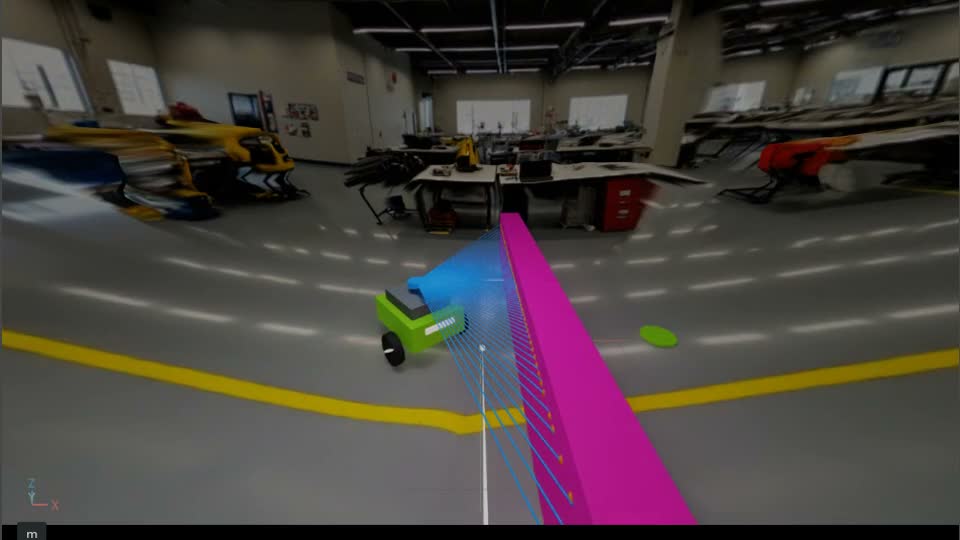
A moving box enters the first detour
The initial sensor-generated route goes below the static crate. A box enters this passage, the robot brakes, and a later plan takes it around the other side.
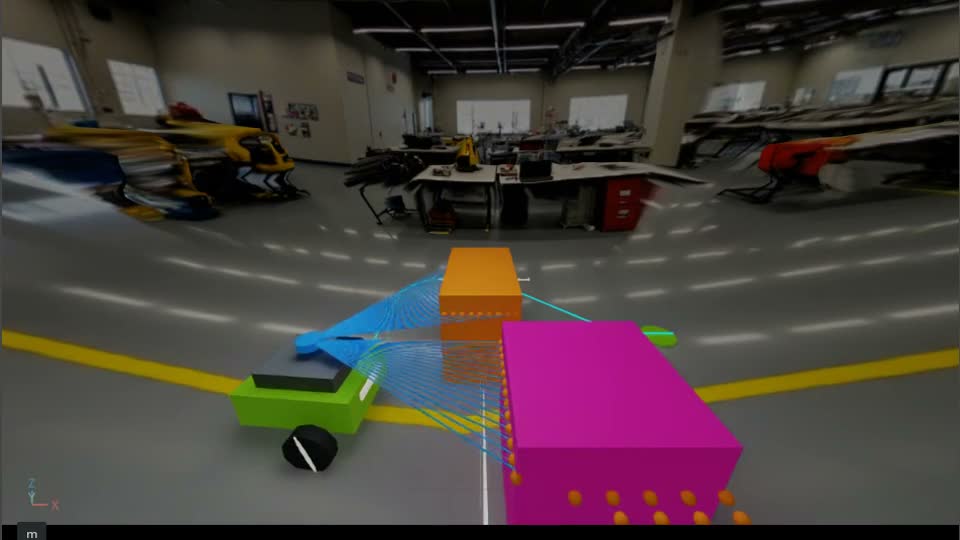
Previous controller: the physical gate opens, but map memory remains
The same range sensor and moving gate, using the unchanged previous permanent-map Navigator. The robot stops and still has no route after the gate withdraws.
Source code
navigation.py
View files on GitHub"""Refresh an observed obstacle map and supervise motion from range scans.
No obstacle poses, actor schedule, or simulator handles enter this module.
This is a small planar educational controller, not a safety-certified stack.
"""
import heapq
import math
from static_navigation import Navigator as StaticNavigator
class Navigator(StaticNavigator):
memory_seconds = 2.0
clear_margin = .10
radius = .52 # 0.425 m axle-centered footprint plus tracking margin.
axle_offset = .10
def __init__(self, goal=(1.3, 0.)):
self.body_goal = tuple(goal)
# Desired final chassis heading is +X. Plan the actual rotation center.
super().__init__((goal[0]+self.axle_offset, goal[1]))
self.observed = {}
self.depths = None
self.front_min = self.nearest = 2.5
self.brake_until = -1.
self.brake_latched = False
self.stats = {'cleared': 0, 'expired': 0, 'occupied': 0}
def control_pose(self, pose):
x, y, yaw = pose
return (x+self.axle_offset*math.cos(yaw), y+self.axle_offset*math.sin(yaw), yaw)
def update(self, pose, depths, endpoints, sim_time):
if (not depths or len(depths) != len(endpoints)
or not all(math.isfinite(v) and .05 <= v <= 2.5001 for v in depths)
or self.last_time is not None and sim_time <= self.last_time):
self.path = []
return False
new_hits = {self.cell(point): (point[0], point[1], sim_time)
for distance, point in zip(depths, endpoints)
if distance < 2.499 and all(math.isfinite(q) for q in point[:2])}
x, y, yaw = pose
cleared = expired = 0
# Compare each old surface with the nearest current beam. A longer beam
# observes free space through that old location. Miss positions are zero
# in the SDK, so they must never be treated as a real XYZ measurement.
for cell, (px, py, stamp) in list(self.observed.items()):
if cell in new_hits:
continue
distance = math.hypot(px-x, py-y)
angle = (math.atan2(py-y, px-x)-yaw+math.pi) % (2*math.pi)
index = int(round(angle/(2*math.pi)*len(depths))) % len(depths)
if distance + self.clear_margin < depths[index]:
del self.observed[cell]
cleared += 1
elif sim_time-stamp > self.memory_seconds:
del self.observed[cell]
expired += 1
self.observed.update(new_hits)
self.hits = set(self.observed)
# Reuse the baseline's inflation and A*, but replace its permanent map
# with the updated observations before every plan.
result = super().update(self.control_pose(pose), depths, endpoints, sim_time)
self.depths = list(depths)
n = len(depths)
self.front_min = min(d for i, d in enumerate(depths)
if abs(-math.pi+2*math.pi*i/n) < math.radians(25))
self.nearest = min(depths)
if self.front_min < .75 and not self.brake_latched:
self.brake_until = sim_time + .6
self.brake_latched = True
if self.front_min > .95:
self.brake_latched = False
self.stats = {'cleared': cleared, 'expired': expired, 'occupied': len(self.observed)}
return result
def plan(self, start):
# Quantization/turning can put the robot's center one cell inside the
# inflated margin. Permit leaving this known self cell, while retaining
# actual measured occupied cells and every neighboring blocked cell.
source = self.cell(start)
if source not in self.hits:
self.blocked.discard(source)
goal = self.cell(self.goal)
if not self.allowed(source) or not self.allowed(goal):
return []
# Prefer continuity with the last sensor-generated plan. This prevents
# tiny scan/grid changes from flipping between equally short detours.
history = [self.cell(point) for point in self.path]
penalties = {}
queue = [(math.dist(source, goal), 0., source)]
costs, parents = {source: 0.}, {}
while queue:
_, cost, node = heapq.heappop(queue)
if cost > costs[node]:
continue
if node == goal:
route = [node]
while route[-1] != source:
route.append(parents[route[-1]])
return [self.point(cell) for cell in reversed(route)]
for dx, dy in ((1,-1),(1,0),(1,1),(0,-1),(0,1),(-1,-1),(-1,0),(-1,1)):
neighbor = (node[0]+dx, node[1]+dy)
if not self.allowed(neighbor):
continue
if dx and dy and (not self.allowed((node[0]+dx,node[1])) or not self.allowed((node[0],node[1]+dy))):
continue
if neighbor not in penalties:
penalties[neighbor] = .08*min(10, min((abs(neighbor[0]-p[0])+abs(neighbor[1]-p[1]) for p in history), default=0))
candidate = cost+math.hypot(dx,dy)+penalties[neighbor]
if candidate < costs.get(neighbor, float('inf')):
costs[neighbor] = candidate
parents[neighbor] = node
heapq.heappush(queue, (candidate+math.dist(neighbor,goal), candidate, neighbor))
return []
def command(self, pose, front_min, sensor_age):
if self.last_time is None or sensor_age > .25:
return 0., 0., 'sensor-stop'
now = self.last_time + sensor_age
if self.nearest < .39:
return 0., 0., 'close-obstacle-stop'
if now < self.brake_until:
return 0., 0., 'obstacle-brake'
control = self.control_pose(pose)
v, omega, phase = super().command(control, self.front_min, sensor_age)
distance = math.dist(control[:2], self.goal)
if phase == 'goal' and distance > .08:
error = math.atan2(math.sin(math.atan2(self.goal[1]-control[1], self.goal[0]-control[0])-pose[2]),
math.cos(math.atan2(self.goal[1]-control[1], self.goal[0]-control[0])-pose[2]))
v = min(.12, .9*distance)*max(0., math.cos(error)) if abs(error) < .65 else 0.
omega, phase = max(-.8, min(.8, 2.8*error)), 'final-approach'
elif phase == 'goal' and abs(pose[2]) > .08:
v, omega, phase = 0., max(-.8, min(.8, -2*pose[2])), 'align-at-goal'
if phase == 'no-path':
return 0., 0., 'wait-for-path'
if self.front_min < .58:
return 0., omega, 'turn-clear' if abs(omega) > .05 else 'obstacle-stop'
return v, omega, phase
static_navigation.py
View files on GitHub"""Small, inspectable scan-to-grid planner; no simulator or scene access.
Inputs are robot pose, a goal, and measured range endpoints. Unknown cells are
optimistically traversable inside a known, flat test boundary. No SLAM is done.
"""
import heapq
import math
class Navigator:
resolution = .05
radius = .43 # Circumscribed robot footprint plus tracking margin.
bounds = (-2.5, -2., 2.5, 2.)
def __init__(self, goal=(1.3, 0.)):
self.goal = tuple(goal)
self.hits = set()
self.path = []
self.replans = 0
self.blocked = set()
self.last_time = None
def cell(self, point):
return tuple(int(round((point[i] - self.bounds[i]) / self.resolution)) for i in (0, 1))
def point(self, cell):
return tuple(self.bounds[i] + cell[i] * self.resolution for i in (0, 1))
def allowed(self, cell):
x, y = self.point(cell)
return (self.bounds[0] + self.radius <= x <= self.bounds[2] - self.radius
and self.bounds[1] + self.radius <= y <= self.bounds[3] - self.radius
and cell not in self.blocked)
def line_free(self, start, end):
n = max(1, math.ceil(math.dist(start, end) / (self.resolution / 2)))
return all(self.allowed(self.cell([start[j] + (end[j] - start[j]) * i / n for j in (0, 1)]))
for i in range(n + 1))
def update(self, pose, depths, endpoints, sim_time):
"""Only measured endpoints within range become occupied cells."""
if not depths or len(depths) != len(endpoints):
self.path = []
return False
if self.last_time is not None and sim_time <= self.last_time:
self.path = []
return False
self.last_time = sim_time
for distance, point in zip(depths, endpoints):
if math.isfinite(distance) and .05 <= distance < 2.499 and all(math.isfinite(q) for q in point[:2]):
self.hits.add(self.cell(point))
n = math.ceil(self.radius / self.resolution)
offsets = [(i, j) for i in range(-n, n+1) for j in range(-n, n+1)
if math.hypot(i, j) * self.resolution <= self.radius + self.resolution / 2]
self.blocked = {(x+i, y+j) for x, y in self.hits for i, j in offsets}
self.path = self.plan(pose[:2])
self.replans += 1
return bool(self.path)
def plan(self, start):
source, goal = self.cell(start), self.cell(self.goal)
if not self.allowed(source) or not self.allowed(goal):
return []
queue = [(math.dist(source, goal), 0., source)]
costs, parents = {source: 0.}, {}
while queue:
_, cost, node = heapq.heappop(queue)
if cost > costs[node]:
continue
if node == goal:
route = [node]
while route[-1] != source:
route.append(parents[route[-1]])
return [self.point(c) for c in reversed(route)]
for dx, dy in ((1, -1), (1, 0), (1, 1), (0, -1), (0, 1), (-1, -1), (-1, 0), (-1, 1)):
neighbor = (node[0]+dx, node[1]+dy)
if not self.allowed(neighbor):
continue
if dx and dy and (not self.allowed((node[0]+dx, node[1])) or not self.allowed((node[0], node[1]+dy))):
continue
candidate = cost + math.hypot(dx, dy)
if candidate < costs.get(neighbor, float('inf')):
costs[neighbor] = candidate
parents[neighbor] = node
heapq.heappush(queue, (candidate + math.dist(neighbor, goal), candidate, neighbor))
return []
def command(self, pose, front_min, sensor_age):
x, y, yaw = pose
distance = math.dist((x, y), self.goal)
if distance < .12:
return 0., 0., 'goal'
if sensor_age > .25 or not self.path:
return 0., 0., 'sensor-stop' if sensor_age > .25 else 'no-path'
target = self.path[0]
for point in self.path:
if math.dist((x, y), point) <= .40 and self.line_free((x, y), point):
target = point
error = math.atan2(math.sin(math.atan2(target[1]-y, target[0]-x)-yaw),
math.cos(math.atan2(target[1]-y, target[0]-x)-yaw))
omega = max(-1.1, min(1.1, 2.8*error))
speed = min(.32, .9*distance) * max(0., math.cos(error)) if abs(error) < .65 else 0.
if front_min < .46:
speed = 0.
return speed, omega, 'follow-scan-path'
actors.py
View files on GitHub"""Scenario actuator, intentionally independent of the sensor controller.
Continuous, finite-speed kinematic targets drive the obstacle in PhysX.
"""
def ramp(t, start, duration):
return max(0., min(1., (t-start)/duration))
def position(scenario, time_s):
if scenario == 'gate':
y = 2.7 * (1-ramp(time_s, 2., 1.8)) + 2.7*ramp(time_s, 8., 1.8)
return [.35, y, .3]
return [.4, -2.7 + 1.75*ramp(time_s, 2., 2.), .3]
def size(scenario):
return [.22, 3.4, .6] if scenario == 'gate' else [.6, .6, .6]
run.sh
View files on GitHub#!/usr/bin/env bash
# Start an isolated Isaac Sim 6.2 container. ACCEPT_EULA must be supplied by the user.
set -euo pipefail
: "${ACCEPT_EULA:?Set ACCEPT_EULA=Y only after accepting the NVIDIA Omniverse agreement.}"
[[ "$ACCEPT_EULA" == Y ]] || { echo "ACCEPT_EULA must be Y after your own acceptance." >&2; exit 1; }
worldgen_lab_root="$(cd "$(dirname "$0")" && pwd)"
worldgen_data_root="${WORLDGEN_DATA_ROOT:-$worldgen_lab_root}"
mkdir -p "$worldgen_data_root/cache"
worldgen_scenario="${1:-gate}"
shift || true
worldgen_xauth="${XAUTHORITY:-/run/user/$(id -u)/gdm/Xauthority}"
worldgen_display="${DISPLAY:-:1}"
worldgen_desktop_args=()
worldgen_headless=false
for worldgen_arg in "$@"; do
[[ "$worldgen_arg" == --headless ]] && worldgen_headless=true
done
if ! "$worldgen_headless"; then
[[ -f "$worldgen_xauth" ]] || { echo "Set XAUTHORITY to your X11 desktop authority file for GUI use." >&2; exit 1; }
worldgen_desktop_args=(-e "DISPLAY=$worldgen_display" -e XAUTHORITY=/tmp/isaac-xauthority
-v "$worldgen_xauth:/tmp/isaac-xauthority:ro" -v /tmp/.X11-unix:/tmp/.X11-unix:rw)
fi
exec docker run --rm --user 0:0 --gpus all --shm-size=2g \
-e ACCEPT_EULA="$ACCEPT_EULA" -e PRIVACY_CONSENT=N -e NVIDIA_DRIVER_CAPABILITIES=all \
"${worldgen_desktop_args[@]}" \
-v "$worldgen_data_root/cache:/root/.cache:rw" \
-v "$worldgen_lab_root:/lab:ro" -v "$worldgen_data_root:/work:rw" \
--entrypoint /isaac-sim/python.sh nvcr.io/nvidia/isaac-sim:6.2.0 \
/lab/run.py --assets /work/assets --output "/work/$worldgen_scenario" --scenario "$worldgen_scenario" \
--allow-root --/omni/client/omniverse/use_omnihub=false --/renderer/multiGpu/enabled=false --/rtx/hydra/supportMultiTickRate=false "$@"
run.py
View files on GitHub"""Dynamic-obstacle navigation in the WorldGen scene.
Scene setup derives from the worldgen-navigation lab (commit 44d2fba).
The Navigator receives scan endpoints and ego pose, never obstacle transforms.
Run inside Isaac Sim 6.2, outside the WorldGen Python environment.
The visual shell is not a collider. The test floor and crate are explicit proxies.
"""
import argparse,json,math,os,time,traceback
from pathlib import Path
from importlib.metadata import version, PackageNotFoundError
p=argparse.ArgumentParser()
p.add_argument('--assets',type=Path,required=True);p.add_argument('--output',type=Path,required=True)
p.add_argument('--scenario',choices=['gate','cart'],default='gate')
p.add_argument('--room-emission',type=float,default=400.);p.add_argument('--headless',action='store_true');p.add_argument('--collision-view',action='store_true')
p.add_argument('--raw-collider',action='store_true');p.add_argument('--no-floor',action='store_true');p.add_argument('--record-handshake',action='store_true')
p.add_argument('--controller',choices=['static','dynamic'],default='dynamic')
p.add_argument('--dropout-start',type=float,default=-1.)
p.add_argument('--dropout-seconds',type=float,default=0.)
p.add_argument('--sensor-off',action='store_true')
p.add_argument('--max-seconds',type=float,default=32.)
p.add_argument('--hold-seconds',type=float,default=2.)
a,kit_args=p.parse_known_args();a.assets=a.assets.resolve();a.output=a.output.resolve();a.output.mkdir(parents=True,exist_ok=True)
(a.output/'FAILED').unlink(missing_ok=True)
from isaacsim import SimulationApp
app=SimulationApp({'headless':a.headless,'width':1280,'height':720,'window_width':1440,'window_height':900,
'renderer':'RaytracedLighting','anti_aliasing':2,'fast_shutdown':True})
failed=True
try:
import numpy as np
import carb,omni.usd,omni.physx
from pxr import Gf,Sdf,UsdGeom,UsdShade,UsdLux,UsdPhysics,PhysxSchema,PhysicsSchemaTools
from isaacsim.core.simulation_manager import SimulationManager
import isaacsim.core.experimental.utils.stage as stage_utils
from isaacsim.core.rendering_manager import RenderingManager, ViewportManager
from omni.kit.viewport.utility import get_active_viewport
settings=carb.settings.get_settings()
settings.set_bool('/physics/updateToUsd',True)
settings.set_bool('/rtx/hydra/readTransformsFromFabricInRenderDelegate',False)
settings.set_bool('/persistent/app/viewport/Viewport/Viewport0/scene/cameras/visible',False)
stage_utils.create_new_stage()
class SimulationLoop:
@property
def current_time(self):return SimulationManager.get_simulation_time()
def initialize(self):
SimulationManager.setup_simulation(dt=1/60)
SimulationManager.initialize_physics()
RenderingManager.set_dt(1/60)
def step(self,render=True):
SimulationManager.step()
if render and not a.headless:RenderingManager.render()
simulation=SimulationLoop()
stage=omni.usd.get_context().get_stage();UsdGeom.SetStageUpAxis(stage,'Z');UsdGeom.SetStageMetersPerUnit(stage,1.)
root=UsdGeom.Xform.Define(stage,'/World');stage.SetDefaultPrim(root.GetPrim())
manifest=json.loads((a.assets/'calibration.json').read_text())
config=manifest['physics_proxy'];robot_cfg=manifest['robot']
def xform(path,pos):
obj=UsdGeom.Xform.Define(stage,path);obj.AddTranslateOp().Set(Gf.Vec3d(*pos));return obj
def material(name,rgb,emission=0):
mat=UsdShade.Material.Define(stage,'/World/Looks/'+name);shader=UsdShade.Shader.Define(stage,mat.GetPath().AppendChild('Surface'))
shader.CreateIdAttr('UsdPreviewSurface');shader.CreateInput('diffuseColor',Sdf.ValueTypeNames.Color3f).Set(Gf.Vec3f(*rgb))
shader.CreateInput('roughness',Sdf.ValueTypeNames.Float).Set(.65)
shader.CreateInput('emissiveColor',Sdf.ValueTypeNames.Color3f).Set(Gf.Vec3f(*(np.array(rgb)*emission)))
mat.CreateSurfaceOutput().ConnectToSource(shader.ConnectableAPI(),'surface');return mat
def bind(obj,mat):UsdShade.MaterialBindingAPI.Apply(obj.GetPrim()).Bind(mat)
green=material('RobotGreen',(.30,.65,.025),.15);dark=material('Rubber',(.045,.05,.055),.05)
steel=material('Steel',(.35,.39,.42));orange=material('TestCrate',(.96,.34,.025),.1);gray=material('ProxyFloor',(.33,.40,.42),.1)
blue=material('Probe',(.03,.35,.95),.2);white=material('Ruler',(.94,.94,.85),.3)
def physics_material(name,friction):
mat=UsdShade.Material.Define(stage,'/World/Looks/'+name);api=UsdPhysics.MaterialAPI.Apply(mat.GetPrim())
api.CreateStaticFrictionAttr(friction);api.CreateDynamicFrictionAttr(friction);api.CreateRestitutionAttr(0.)
return mat
traction=physics_material('Traction',.9);caster_mat=physics_material('Caster',.015)
def box(path,pos,size,mat,collision=False):
o=UsdGeom.Cube.Define(stage,path);o.CreateSizeAttr(1.);o.AddTranslateOp().Set(Gf.Vec3d(*pos));o.AddScaleOp().Set(Gf.Vec3d(*size));bind(o,mat)
if collision:UsdPhysics.CollisionAPI.Apply(o.GetPrim())
return o
def rigid(obj,mass):
UsdPhysics.RigidBodyAPI.Apply(obj.GetPrim());UsdPhysics.MassAPI.Apply(obj.GetPrim()).CreateMassAttr(mass)
# The render mesh is a decimation of the generated RGB-distance shell.
mesh_data=np.load(a.assets/'room-mesh.npz');mesh=UsdGeom.Mesh.Define(stage,'/World/GeneratedRoom')
mesh.CreatePointsAttr(mesh_data['points']);mesh.CreateFaceVertexCountsAttr([3]*len(mesh_data['indices']));mesh.CreateFaceVertexIndicesAttr(mesh_data['indices'].reshape(-1))
mesh.CreateSubdivisionSchemeAttr('none');mesh.CreateDoubleSidedAttr(True)
UsdGeom.PrimvarsAPI(mesh).CreatePrimvar('st',Sdf.ValueTypeNames.TexCoord2fArray,UsdGeom.Tokens.vertex).Set(mesh_data['uv'])
mesh.CreateExtentAttr([Gf.Vec3f(*mesh_data['points'].min(0).tolist()),Gf.Vec3f(*mesh_data['points'].max(0).tolist())])
# Native OmniPBR avoids the PreviewSurface texture-graph translation on RTX.
room_mat=UsdShade.Material.Define(stage,'/World/Looks/Room')
room_shader=UsdShade.Shader.Define(stage,'/World/Looks/Room/Shader')
room_shader.CreateIdAttr('OmniPBR')
room_shader.GetImplementationSourceAttr().Set(UsdShade.Tokens.sourceAsset)
room_shader.SetSourceAsset(Sdf.AssetPath('OmniPBR.mdl'),'mdl')
room_shader.SetSourceAssetSubIdentifier('OmniPBR','mdl')
out=room_shader.CreateOutput('out',Sdf.ValueTypeNames.Token)
room_mat.CreateSurfaceOutput('mdl').ConnectToSource(out)
for name in ['diffuse_texture','emissive_color_texture']:
room_shader.CreateInput(name,Sdf.ValueTypeNames.Asset).Set(Sdf.AssetPath(str(a.assets/'panorama.jpg')))
room_shader.CreateInput('project_uvw',Sdf.ValueTypeNames.Bool).Set(False)
room_shader.CreateInput('texture_scale',Sdf.ValueTypeNames.Float2).Set(Gf.Vec2f(1,1))
room_shader.CreateInput('diffuse_color_constant',Sdf.ValueTypeNames.Color3f).Set(Gf.Vec3f(1))
room_shader.CreateInput('reflection_roughness_constant',Sdf.ValueTypeNames.Float).Set(1.)
room_shader.CreateInput('enable_emission',Sdf.ValueTypeNames.Bool).Set(True)
room_shader.CreateInput('emissive_color',Sdf.ValueTypeNames.Color3f).Set(Gf.Vec3f(1))
room_shader.CreateInput('emissive_intensity',Sdf.ValueTypeNames.Float).Set(a.room_emission)
bind(mesh,room_mat)
if a.raw_collider:
UsdPhysics.CollisionAPI.Apply(mesh.GetPrim())
UsdPhysics.MeshCollisionAPI.Apply(mesh.GetPrim()).CreateApproximationAttr('none')
if a.collision_view:mesh.CreateVisibilityAttr('invisible')
if not a.no_floor:
floor=box('/World/ProxyFloor',config['floor_center'],config['floor_size'],gray,True)
UsdShade.MaterialBindingAPI.Apply(floor.GetPrim()).Bind(traction,materialPurpose='physics')
if not a.collision_view:floor.CreateVisibilityAttr('invisible')
import actors
obstacle_paths=['/World/MovingObstacle']
purple=material('MovingObstacle',(.65,.025,.38),.22)
moving=xform('/World/MovingObstacle',actors.position(a.scenario,0.));rigid(moving,50.)
UsdPhysics.RigidBodyAPI(moving.GetPrim()).CreateKinematicEnabledAttr(True)
actor_collider=box('/World/MovingObstacle/Geometry',(0,0,0),actors.size(a.scenario),purple,True)
actor_collider.CreateVisibilityAttr('invisible')
# The compatibility renderer needs an explicit visual mirror for targets
# driven through the physics tensor API. It follows measured solver state.
display=xform('/World/MovingDisplay',actors.position(a.scenario,0.))
display_translate=UsdGeom.Xformable(display).GetOrderedXformOps()[0]
box('/World/MovingDisplay/Geometry',(0,0,0),actors.size(a.scenario),purple)
if a.scenario=='cart':
crate=box('/World/TestCrate',config['obstacle_center'],config['obstacle_size'],orange,True)
obstacle_paths.append('/World/TestCrate')
# One metre, in the chosen simulation scale, rather than a claim about the generated simulation.
box('/World/OneMetreBar',(0,.95,.06),(1,.015,.01),white)
for x in np.linspace(-.5,.5,11):box(f'/World/Tick{int(round((x+.5)*10))}',(float(x),.95,.065),(.01,.06 if abs(x)>.49 else .035,.01),white)
paths=[];drives=[]
if a.scenario=='probes':
for i,(x,y) in enumerate([(-1,-.7),(-1,.7),(1,-.7),(1,.7)]):
obj=xform(f'/World/Probe{i}',(x,y,.75));rigid(obj,.1)
if not a.headless:PhysxSchema.PhysxRigidBodyAPI.Apply(obj.GetPrim()).CreateDisableGravityAttr(True)
box(str(obj.GetPath())+'/Geometry',(0,0,0),(.1,.1,.1),blue,True);paths.append(str(obj.GetPath()))
else:
robot=xform('/World/Robot',(0,0,0));UsdPhysics.ArticulationRootAPI.Apply(robot.GetPrim())
PhysxSchema.PhysxArticulationAPI.Apply(robot.GetPrim()).CreateEnabledSelfCollisionsAttr(False)
start=np.array(manifest['route']['start']);chassis=xform('/World/Robot/Chassis',start);rigid(chassis,8.)
PhysxSchema.PhysxContactReportAPI.Apply(chassis.GetPrim()).CreateThresholdAttr(0)
box('/World/Robot/Chassis/Body',(0,0,0),robot_cfg['body_size'],green,True)
box('/World/Robot/Chassis/Top',(0,0,.13),(.38,.30,.08),steel)
box('/World/Robot/Chassis/Front',(.28,0,.035),(.012,.22,.04),white)
caster=UsdGeom.Sphere.Define(stage,'/World/Robot/Chassis/Caster');caster.CreateRadiusAttr(.05);caster.AddTranslateOp().Set(Gf.Vec3d(-.21,0,-.18));bind(caster,dark)
UsdPhysics.CollisionAPI.Apply(caster.GetPrim());UsdShade.MaterialBindingAPI.Apply(caster.GetPrim()).Bind(caster_mat,materialPurpose='physics')
for i,y in enumerate([.26,-.26]):
path=f'/World/Robot/Wheel{i}';local=np.array([.10,y,-.12]);wheel=xform(path,start+local);rigid(wheel,.3);PhysxSchema.PhysxContactReportAPI.Apply(wheel.GetPrim()).CreateThresholdAttr(0)
cylinder=UsdGeom.Cylinder.Define(stage,path+'/Tyre');cylinder.CreateAxisAttr('Y');cylinder.CreateRadiusAttr(.11);cylinder.CreateHeightAttr(.06);bind(cylinder,dark)
UsdPhysics.CollisionAPI.Apply(cylinder.GetPrim());UsdShade.MaterialBindingAPI.Apply(cylinder.GetPrim()).Bind(traction,materialPurpose='physics')
for j in range(3):
spoke=box(path+f'/Spoke{j}',(0,(-.031 if y<0 else .031),0),(.16,.006,.015),white)
spoke.AddRotateYOp().Set(j*60.)
joint=UsdPhysics.RevoluteJoint.Define(stage,f'/World/Robot/Joint{i}');joint.CreateAxisAttr('Y')
joint.CreateBody0Rel().SetTargets([chassis.GetPath()]);joint.CreateBody1Rel().SetTargets([wheel.GetPath()])
joint.CreateLocalPos0Attr(Gf.Vec3f(*local));joint.CreateLocalPos1Attr(Gf.Vec3f(0))
drive=UsdPhysics.DriveAPI.Apply(joint.GetPrim(),'angular');drive.CreateTypeAttr('force');drive.CreateStiffnessAttr(0);drive.CreateDampingAttr(20);drive.CreateMaxForceAttr(6);drive.CreateTargetVelocityAttr(0)
drives.append(drive)
paths=['/World/Robot/Chassis']
from isaacsim.sensors.experimental.physics import Raycast,RaycastSensor
if a.controller=='dynamic':
from navigation import Navigator
else:
from static_navigation import Navigator
angles=np.linspace(-math.pi,math.pi,180,endpoint=False)
scanner=RaycastSensor(Raycast.create('/World/Robot/Chassis/RangeSensor',
ray_origins=[[0.,0.,0.]]*len(angles),ray_directions=[[math.cos(t),math.sin(t),0.] for t in angles],
min_range=.05,max_range=2.5,output_frame='WORLD',translations=[[0.,0.,.25]]))
cap=UsdGeom.Cylinder.Define(stage,'/World/Robot/Chassis/SensorCap');cap.CreateAxisAttr('Z');cap.CreateRadiusAttr(.06);cap.CreateHeightAttr(.04);cap.AddTranslateOp().Set(Gf.Vec3d(0,0,.24));bind(cap,blue)
cyan=material('LiveSensor',(.015,.8,.85),.7)
def curve(path,mat,width):
c=UsdGeom.BasisCurves.Define(stage,path);c.CreateTypeAttr('linear');c.CreateWidthsAttr([width]);c.SetWidthsInterpolation('constant');bind(c,mat);c.CreateVisibilityAttr('invisible');return c
scan_lines=curve('/World/LiveScan',blue,.006);path_line=curve('/World/PlannedPath',cyan,.012)
map_points=UsdGeom.Points.Define(stage,'/World/ObservedMap');map_points.CreateWidthsAttr([.035]);map_points.SetWidthsInterpolation('constant');bind(map_points,orange);map_points.CreateVisibilityAttr('invisible')
goal_marker=UsdGeom.Cylinder.Define(stage,'/World/Goal');goal_marker.CreateRadiusAttr(.12);goal_marker.CreateHeightAttr(.015);goal_marker.AddTranslateOp().Set(Gf.Vec3d(1.3,0,.055));bind(goal_marker,green)
timing={'sensor_s':0.,'planner_s':0.,'draw_s':0.,'step_s':0.}
navigator=Navigator();scan_log=[];last_scan_time=-1e9;front_min=2.5
# Save the source scene before stepping. The exported state can be inspected in the GUI.
def aim(camera,eye,target):
matrix=Gf.Matrix4d(1).SetLookAt(Gf.Vec3d(*eye),Gf.Vec3d(*target),Gf.Vec3d(0,0,1)).GetInverse()
UsdGeom.Xformable(camera).AddTransformOp().Set(matrix)
camera=UsdGeom.Camera.Define(stage,'/World/FilmCamera');camera.GetPrim().ApplyAPI('OmniSensorAPI');aim(camera,(0,-1.8,1.35),(0,.6,.45));camera.CreateFocalLengthAttr(11);camera.CreateHorizontalApertureAttr(36);camera.CreateClippingRangeAttr(Gf.Vec2f(.03,120))
dome=UsdLux.DomeLight.Define(stage,'/World/Dome');dome.CreateIntensityAttr(450)
key=UsdLux.SphereLight.Define(stage,'/World/Light');key.AddTranslateOp().Set(Gf.Vec3d(-.3,-.5,2.1));key.CreateIntensityAttr(1800);key.CreateRadiusAttr(.7)
stage.Export(str(a.output/'scene.usdc'))
portable=Sdf.Layer.FindOrOpen(str(a.output/'scene.usdc'))
for name in ['diffuse_texture','emissive_color_texture']:
portable.GetAttributeAtPath('/World/Looks/Room/Shader.inputs:'+name).default=Sdf.AssetPath(os.path.relpath(a.assets/'panorama.jpg',a.output))
portable.Save()
simulation.initialize()
if not a.headless:
viewport=get_active_viewport();ViewportManager.set_camera(camera)
import asyncio
from omni.kit.viewport.utility import capture_viewport_to_file
from PIL import Image
for _ in range(8):
simulation.step()
capture=capture_viewport_to_file(viewport,str(a.output/'initial-rgb.png'))
async def wait_for_frame():
return await asyncio.wait_for(capture.wait_for_result(),timeout=120)
app.run_coroutine(wait_for_frame())
image_deadline=time.monotonic()+10
while True:
try:
with Image.open(a.output/'initial-rgb.png') as frame:
pixels=np.array(frame)
break
except (FileNotFoundError,OSError):
if time.monotonic()>image_deadline:raise
RenderingManager.render();time.sleep(.02)
(a.output/'initial-rgb.png').chmod(0o644)
assert pixels.ndim==3 and pixels[:,:,:3].mean()>5,'Native viewport remained black'
print('RENDER_CHECK',pixels.shape,float(pixels[:,:,:3].mean()),flush=True)
if a.scenario=='probes':
for _ in range(40):RenderingManager.render()
else:
for _ in range(40):simulation.step(render=True)
inspector=omni.physx.get_physx_interface()
import omni.physics.tensors as tensors
tensor_sim=tensors.create_simulation_view('numpy',stage_id=stage_utils.get_stage_id(stage))
actor_view=tensor_sim.create_rigid_body_view('/World/MovingObstacle')
assert actor_view.count==1
actor_indices=np.array([0],dtype=np.uint32)
def pose(path):
v=inspector.get_rigidbody_transformation(path);assert v['ret_val'],path
return list(v['position']),list(v['rotation'])
raycasts={}
for name,xy in [('floor_left',[-1,-1]),('floor_right',[1,-1]),('crate',[0,0])]:
hit=omni.physx.get_physx_scene_query_interface().raycast_closest((xy[0],xy[1],2.),(0.,0.,-1.),5.)
raycasts[name]={'hit':bool(hit['hit']),'collider':str(hit.get('collision','')),'position':list(hit.get('position',[]))}
contacts=[]
def on_contact(headers,data):
for header in headers:
actor0=str(PhysicsSchemaTools.intToSdfPath(header.actor0));actor1=str(PhysicsSchemaTools.intToSdfPath(header.actor1))
if any(path in actor0+actor1 for path in obstacle_paths) and 'Robot' in actor0+actor1:
contacts.append({'actor0':actor0,'actor1':actor1,'type':int(header.type),'time':simulation.current_time})
subscription=omni.physx.get_physx_simulation_interface().subscribe_contact_report_events(on_contact)
if a.record_handshake:
(a.output/'ready.json').write_text(json.dumps({'camera':str(camera.GetPath()),'application':'Isaac Sim 6.2 native window'}))
deadline=time.monotonic()+60
while not (a.output/'record-go').exists():
if time.monotonic()>deadline:raise TimeoutError('Native recorder did not start')
RenderingManager.render()
if a.scenario!='probes':
for _ in range(45):simulation.step(render=True)
print('NATIVE_GUI_RECORDING_STARTED',flush=True)
if a.scenario=='probes' and not a.headless:
for path in paths:PhysxSchema.PhysxRigidBodyAPI.Get(stage,path).GetDisableGravityAttr().Set(False)
paths.append('/World/MovingObstacle')
samples=[];phase_events=[];cleared_total=expired_total=0
steps=int(a.max_seconds*60)
start_wall=time.monotonic();start_sim=simulation.current_time;reached=False;goal_time=None;phase='starting'
for step in range(steps):
position,rotation=pose(paths[0]);x,y,z=position;qx,qy,qz,qw=rotation
yaw=math.atan2(2*(qw*qz+qx*qy),1-2*(qy*qy+qz*qz))
elapsed=simulation.current_time-start_sim
actor_target=np.array([actors.position(a.scenario,elapsed)+[0.,0.,0.,1.]],dtype=np.float32)
actor_view.set_kinematic_targets(actor_target,actor_indices)
dropout=a.dropout_start<=elapsed<a.dropout_start+a.dropout_seconds
if step%6==0 and not a.sensor_off and not dropout:
tick=time.perf_counter()
frame=scanner.get_data()
depths=np.asarray(frame['depths']).reshape(-1).astype(float).tolist()
endpoints=np.asarray(frame['hit_positions']).reshape(-1,3).astype(float).tolist()
reading_time=float(frame['time'])
assert len(depths)==180 and all(math.isfinite(q) for q in depths),'Invalid range scan'
last_scan_time=reading_time
# hit prim paths and scene objects are deliberately not passed to the planner.
timing['sensor_s']+=time.perf_counter()-tick;tick=time.perf_counter()
navigator.update((x,y,yaw),depths,endpoints,reading_time)
stats=getattr(navigator,'stats',{'cleared':0,'expired':0,'occupied':len(navigator.hits)})
cleared_total+=stats['cleared'];expired_total+=stats['expired']
timing['planner_s']+=time.perf_counter()-tick;tick=time.perf_counter()
forward=[d for t,d in zip(angles,depths) if abs(t)<math.radians(25)]
front_min=min(forward)
scan_log.append({'sim_time_s':elapsed,'sensor_time_s':reading_time,'pose_xyyaw':[x,y,yaw],
'depths_m':depths,'hit_positions_world':endpoints,'front_min_m':front_min,
'planned_path_xy':navigator.path,'occupied_cells':len(navigator.hits),'map_update':stats})
sensor_origin=[x,y,z+.25]
line_points=[]
for d,pt in zip(depths,endpoints):
if .05<=d<2.499:line_points.extend([sensor_origin,pt])
if line_points:
scan_lines.CreatePointsAttr([Gf.Vec3f(*pt) for pt in line_points]);scan_lines.CreateCurveVertexCountsAttr([2]*(len(line_points)//2));scan_lines.CreateVisibilityAttr('inherited')
else:scan_lines.CreateVisibilityAttr('invisible')
path_points=[Gf.Vec3f(q[0],q[1],.075) for q in navigator.path]
if len(path_points)>1:
path_line.CreatePointsAttr(path_points);path_line.CreateCurveVertexCountsAttr([len(path_points)]);path_line.CreateVisibilityAttr('inherited')
else:path_line.CreateVisibilityAttr('invisible')
cells=[Gf.Vec3f(*navigator.point(cell),.48) for cell in navigator.hits]
if cells:
map_points.CreatePointsAttr(cells);map_points.CreateExtentAttr([Gf.Vec3f(*[min(p[i] for p in cells)-.02 for i in range(3)]),Gf.Vec3f(*[max(p[i] for p in cells)+.02 for i in range(3)])]);map_points.CreateVisibilityAttr('inherited')
else:map_points.CreateVisibilityAttr('invisible')
timing['draw_s']+=time.perf_counter()-tick
v=omega=0.
sensor_age=simulation.current_time-last_scan_time
v,omega,phase=navigator.command((x,y,yaw),front_min,sensor_age)
reached=phase=='goal'
if not phase_events or phase_events[-1]['phase']!=phase:
phase_events.append({'time_s':elapsed,'phase':phase,'position_xyz':position,'front_min_m':front_min})
for drive,speed in zip(drives,[(v-.26*omega)/.11,(v+.26*omega)/.11]):
drive.GetTargetVelocityAttr().Set(math.degrees(speed))
tick=time.perf_counter();simulation.step(render=False)
actual_actor_position=pose('/World/MovingObstacle')[0]
display_translate.Set(Gf.Vec3d(*actual_actor_position))
if not a.headless:RenderingManager.render()
timing['step_s']+=time.perf_counter()-tick
if step%60==0:print('SIM_STEP',step,phase,front_min,position,flush=True)
if step%6==0:
samples.append({'step':step,'sim_time_s':simulation.current_time-start_sim,'wall_s':time.monotonic()-start_wall,
'poses':{path:pose(path) for path in paths},'command':[v,omega],'waypoint':None,'dropout_injected':dropout,'obstacle_target_xyz':actor_target[0,:3].tolist(),'render_position_xyz':list(display_translate.Get()),
'phase':phase,'front_min_m':front_min,'sensor_age_s':simulation.current_time-last_scan_time if last_scan_time>0 else None})
if reached:
if goal_time is None:goal_time=elapsed
if elapsed-goal_time>=a.hold_seconds:break
if not a.headless:time.sleep(max(0,(step+1)/60-(time.monotonic()-start_wall)))
for drive in drives:drive.GetTargetVelocityAttr().Set(0)
try: sim_version=version('isaacsim')
except PackageNotFoundError:
from isaacsim.core.version import get_version
sim_version=get_version()[0]
result={'status':'complete','scenario':a.scenario,'controller':a.controller,'sensor_off':a.sensor_off,'collision_view':a.collision_view,'no_floor':a.no_floor,'raw_collider':a.raw_collider,
'isaacsim_version':sim_version,'physics':'live PhysX; joint velocity drives; not a USD trajectory replay',
'control':'range sensor → refreshed occupancy → A* → stop supervisor → physical wheel drives' if a.controller=='dynamic' else 'previous static accumulating-map sensor controller',
'moving_actor':{'type':'PhysX kinematic rigid body driven by set_kinematic_targets','size':actors.size(a.scenario),'schedule_passed_to_controller':False,'display':'non-colliding visual prim synchronized from actual PhysX pose every physics step','motion':'gate enters 2–3.8 s, withdraws 8–9.8 s' if a.scenario=='gate' else 'box enters the lower passage 2–4 s, then remains'},
'dropout':{'start_s':a.dropout_start,'duration_s':a.dropout_seconds},'map_cleared_total':cleared_total,'map_expired_total':expired_total,
'timing':timing,'sensor':{'class':'isaacsim.sensors.experimental.physics.RaycastSensor','rays':180,'max_range_m':2.5,'height_above_chassis_m':.25,'controller_read_hz':10,'scan_frames':len(scan_log),'replans':navigator.replans},
'navigation':{'obstacle_transforms_as_input':False,'known_floor_bounds':navigator.bounds,'inflation_radius_m':navigator.radius,'grid_resolution_m':navigator.resolution,'goal_xy':navigator.goal,'body_goal_xy':[1.3,0.],
'control_reference':'axle midpoint 0.10 m ahead of chassis' if a.controller=='dynamic' else 'chassis center',
'desired_final_heading_rad':0. if a.controller=='dynamic' else None,'pose_source':'simulator ground truth; not SLAM or wheel odometry'},
'phase_events':phase_events,'goal_reached_s':goal_time,'start_sim_s':start_sim,'duration_sim_s':simulation.current_time-start_sim,'duration_wall_s':time.monotonic()-start_wall,'reached_goal':reached,
'stage':{'up_axis':str(UsdGeom.GetStageUpAxis(stage)),'meters_per_unit':UsdGeom.GetStageMetersPerUnit(stage),'render_mesh_collision':mesh.GetPrim().HasAPI(UsdPhysics.CollisionAPI),'multitick_rendering':settings.get_as_bool('/rtx/hydra/supportMultiTickRate'),'room_emission_display_setting':a.room_emission,'proxy_floor':not a.no_floor},'raycasts':raycasts,'crate_contact_events':contacts,'samples':samples,'final_poses':{path:pose(path) for path in paths}}
(a.output/'scans.json').write_text(json.dumps(scan_log,separators=(',',':'))+'\n')
(a.output/'result.json').write_text(json.dumps(result,indent=2)+'\n')
print('RUN_RESULT',json.dumps({k:v for k,v in result.items() if k not in ['samples','crate_contact_events']}),flush=True)
failed=False
except BaseException:
traceback.print_exc()
finally:
if failed:(a.output/'FAILED').touch()
app.close()
if failed:raise SystemExit(1)
record_gui.py
View files on GitHub"""Record the real native Isaac Sim window while run.py performs live physics."""
import argparse,json,os,signal,subprocess,time
from pathlib import Path
p=argparse.ArgumentParser();p.add_argument('--work',type=Path,required=True)
p.add_argument('--scenario',choices=['gate','cart'],default='gate')
p.add_argument('--ffmpeg',type=Path,required=True);p.add_argument('--collision-view',action='store_true')
p.add_argument('--controller',choices=['static','dynamic'],default='dynamic');p.add_argument('--max-seconds',default='32')
a=p.parse_args();root=Path(__file__).resolve().parent;a.work=a.work.resolve()
output=a.work/a.scenario;output.mkdir(parents=True,exist_ok=True)
assert not (output/'ready.json').exists(),'Use a new output folder for a fresh recording'
env=dict(os.environ,WORLDGEN_DATA_ROOT=str(a.work),DISPLAY=os.environ.get('DISPLAY',':1'),XAUTHORITY=os.environ.get('XAUTHORITY',f'/run/user/{os.getuid()}/gdm/Xauthority'))
command=['bash',str(root/'run.sh'),a.scenario,'--record-handshake','--controller',a.controller,'--max-seconds',a.max_seconds]+(['--collision-view'] if a.collision_view else [])
recorder=None
with (output/'simulator.log').open('w') as log:
process=subprocess.Popen(command,env=env,stdout=log,stderr=subprocess.STDOUT)
try:
deadline=time.monotonic()+240
while not (output/'ready.json').exists():
if process.poll() is not None:raise RuntimeError('Isaac Sim stopped before the viewport was ready; see simulator.log')
if time.monotonic()>deadline:raise TimeoutError('Isaac Sim startup timed out')
time.sleep(.3)
listing=subprocess.check_output(['xwininfo','-root','-tree'],env=env,text=True)
window=next(row.split()[0] for row in listing.splitlines() if ('"Isaac Sim' in row or '"Isaac-Sim' in row) and 'mutter-x11-frames' not in row)
metadata=subprocess.check_output(['xwininfo','-id',window],env=env,text=True)
(output/'window.txt').write_text(metadata)
with (output/'recorder.log').open('w') as recordlog:
recorder=subprocess.Popen([str(a.ffmpeg),'-nostdin','-hide_banner','-loglevel','warning','-y','-f','x11grab','-draw_mouse','0','-framerate','30','-window_id',str(int(window,16)),'-i',env['DISPLAY']+'.0','-an','-vf','scale=trunc(iw/2)*2:trunc(ih/2)*2','-c:v','libx264','-preset','ultrafast','-crf','18','-pix_fmt','yuv420p','-movflags','+faststart',str(output/'native-gui.mp4')],env=env,stdout=recordlog,stderr=subprocess.STDOUT)
time.sleep(.5);assert recorder.poll() is None,'X11 recorder could not start'
(output/'record-go').touch()
process.wait(timeout=300)
if (output/'FAILED').exists() or not (output/'result.json').exists():raise RuntimeError('Simulation failed; keep the logs for diagnosis')
finally:
if recorder and recorder.poll() is None:
recorder.send_signal(signal.SIGINT);recorder.wait(timeout=15)
if process.poll() is None:process.terminate()
print('Native GUI recording:',output/'native-gui.mp4')
package.py
View files on GitHub"""Package native GUI crops and an honest sequential controller comparison.
Requires ffmpeg and Pillow on the editing machine. All footage stays at 1×.
"""
import argparse,hashlib,json,subprocess,tempfile
from pathlib import Path
from PIL import Image,ImageDraw,ImageFont
p=argparse.ArgumentParser();p.add_argument('--source',type=Path,required=True);p.add_argument('--output',type=Path,required=True)
p.add_argument('--ffmpeg',default='ffmpeg');p.add_argument('--font',required=True);p.add_argument('--font-ko',required=True)
a=p.parse_args();a.output.mkdir(parents=True,exist_ok=True)
def ff(*args):subprocess.run([a.ffmpeg,'-hide_banner','-loglevel','error','-y',*map(str,args)],check=True)
def digest(path):return hashlib.sha256(path.read_bytes()).hexdigest()
records={}
for label,scenario,stem in [('gate-dynamic','gate','worldgen-dynamic-navigation-gate'),('gate-static','gate','worldgen-dynamic-navigation-static'),('cart-dynamic','cart','worldgen-dynamic-navigation-cart')]:
folder=a.source/label/scenario
assert 'Width: 1440' in (folder/'window.txt').read_text() and 'Height: 900' in (folder/'window.txt').read_text()
r=json.loads((folder/'result.json').read_text());duration=r['duration_wall_s']+.95
output=a.output/(stem+'.mp4')
ff('-ss','0.4','-i',folder/'native-gui.mp4','-t',duration,'-an','-vf','crop=952:536:50:64,scale=960:540',
'-c:v','libx264','-preset','slow','-crf','23','-pix_fmt','yuv420p','-movflags','+faststart',output)
ff('-ss','5','-i',output,'-frames:v','1',a.output/(stem+'.jpg'))
records[stem]={'source_native_sha256':digest(folder/'native-gui.mp4'),'crop_xywh':[50,64,952,536],
'trim_start_s':.4,'speed':1.,'duration_limit_s':duration,'simulation_s':r['duration_sim_s'],
'simulation_wall_s':r['duration_wall_s'],'goal_reached_s':r['goal_reached_s'],'published_sha256':digest(output)}
# The complete sensor take is shown after a 13 s excerpt of the previous controller.
# A hard cut and persistent labels distinguish separate real simulator runs.
with tempfile.TemporaryDirectory() as directory:
temp=Path(directory)
for lang in ['en','ko']:
font=ImageFont.truetype(a.font if lang=='en' else a.font_ko,25)
labels=['Previous | Sensor + permanent obstacle map','Updated | Clear old hits, stop and replan'] if lang=='en' else ['이전 방식 | 센서 관측을 계속 쌓는 지도','새 방식 | 지도 갱신·정지·경로 재계획']
parts=[]
for i,(name,text) in enumerate(zip(['worldgen-dynamic-navigation-static','worldgen-dynamic-navigation-gate'],labels)):
badge=Image.new('RGBA',(960,48),(247,249,250,235));draw=ImageDraw.Draw(badge)
draw.rectangle((0,0,5,48),fill='#76b900');draw.text((17,9),text,font=font,fill='#1b252b')
png=temp/f'label-{lang}-{i}.png';badge.save(png)
part=temp/f'part-{lang}-{i}.mp4';parts.append(part)
options=['-i',a.output/(name+'.mp4'),'-i',png,'-filter_complex','[0:v][1:v]overlay=0:0:format=auto,format=yuv420p']
if i==0:options+=['-t','13']
ff(*options,'-an','-c:v','libx264','-preset','slow','-crf','23',part)
listing=temp/f'concat-{lang}.txt';listing.write_text(''.join(f"file '{part}'\n" for part in parts))
stem='worldgen-dynamic-navigation' if lang=='en' else 'worldgen-dynamic-navigation-ko'
output=a.output/(stem+'.mp4')
ff('-f','concat','-safe','0','-i',listing,'-c','copy','-movflags','+faststart',output)
ff('-ss','19','-i',output,'-frames:v','1',a.output/(stem+'.jpg'))
records[stem]={'edit':'13 s previous permanent-map excerpt, then complete refreshed-map gate take; labeled hard cut',
'sources':['worldgen-dynamic-navigation-static','worldgen-dynamic-navigation-gate'],'speed':1.,'published_sha256':digest(output)}
(a.output/'dynamic-edit.json').write_text(json.dumps(records,indent=2)+'\n')
print('Native crops and bilingual sequential comparison packaged at 1× speed.')
plot.py
View files on GitHub"""Plot recorded physical trajectories; these figures are not simulator footage."""
import argparse,json,math
from pathlib import Path
import matplotlib
matplotlib.use('Agg')
import matplotlib.pyplot as plt
from matplotlib.patches import Rectangle
from matplotlib.font_manager import FontProperties
p=argparse.ArgumentParser();p.add_argument('--evidence',type=Path,required=True);p.add_argument('--output',type=Path,required=True);p.add_argument('--font');a=p.parse_args();a.output.mkdir(parents=True,exist_ok=True)
if a.font:plt.rcParams['font.family']=FontProperties(fname=a.font).get_name()
plt.rcParams.update({'svg.fonttype':'path','axes.unicode_minus':False,'font.size':11})
runs={name:json.loads((a.evidence/name/'result.json').read_text()) for name in ['gate-static','gate-dynamic','cart-dynamic']}
def save(fig,name):
path=a.output/name;fig.savefig(path);fig.savefig(path.with_suffix(".png"),dpi=140);plt.close(fig)
path.write_text('\n'.join(line.rstrip() for line in path.read_text().splitlines())+'\n')
for lang in ['en','ko']:
fig,axes=plt.subplots(2,1,figsize=(8,6),layout='constrained',sharex=True);fig.patch.set_facecolor('#f5f7f8')
new=runs['gate-dynamic'];samples=new['samples'];times=[s['sim_time_s'] for s in samples]
axes[0].plot(times,[s['poses']['/World/MovingObstacle'][0][1] for s in samples],c='#a13286',lw=2)
axes[0].set_ylabel('Gate Y (m)' if lang=='en' else '차단벽 Y (m)')
axes[0].set_title('Actual gate position and robot progress' if lang=='en' else '실제 차단벽 위치와 로봇의 진행')
for case,color,label in [('gate-static','#c27037','Previous map' if lang=='en' else '이전 지도'),('gate-dynamic','#659f00','Updated map' if lang=='en' else '새 지도')]:
s=runs[case]['samples'];axes[1].plot([v['sim_time_s'] for v in s],[v['poses']['/World/Robot/Chassis'][0][0] for v in s],color=color,lw=2.2,label=label)
axes[1].set(ylabel='Robot X (m)' if lang=='en' else '로봇 X (m)',xlabel='Simulation time (s)' if lang=='en' else '시뮬레이션 시간 (초)')
axes[1].legend(loc='lower right')
for ax in axes:
ax.axvspan(3.8,8.,color='#a13286',alpha=.07);ax.axvline(9.8,color='#9dabb4',ls='--',lw=1);ax.grid(alpha=.16)
for spine in ax.spines.values():spine.set_edgecolor('#ced6db')
fig.suptitle('The route opens, but permanent map memory still blocks the old planner' if lang=='en' else '길은 열렸지만 이전 지도에는 장애물이 남습니다',fontsize=13)
save(fig,f'gate.{lang}.svg')
r=runs['cart-dynamic'];samples=r['samples'];scans=json.loads((a.evidence/'cart-dynamic/scans.json').read_text())
fig,ax=plt.subplots(figsize=(7,6),layout='constrained');fig.patch.set_facecolor('#f5f7f8')
ax.add_patch(Rectangle((-2.5,-2),5,4,facecolor='#fafbfc',edgecolor='#b7c4cb'))
ax.add_patch(Rectangle((-.225,-.4),.45,.8,color='#e5a14d',alpha=.9))
ax.add_patch(Rectangle((.1,-1.25),.6,.6,color='#a13286',alpha=.8))
ax.add_patch(Rectangle((.1,-3),.6,.6,fill=False,edgecolor='#a13286',ls='--'))
ax.annotate('',xy=(.4,-1.3),xytext=(.4,-2.35),arrowprops={'arrowstyle':'->','color':'#a13286','lw':2})
initial=scans[0]['planned_path_xy'];ax.plot([p[0] for p in initial],[p[1] for p in initial],'--',c='#3b9cae',lw=1.4,label='First computed axle path' if lang=='en' else '처음 계산한 차축 경로')
points=[s['poses']['/World/Robot/Chassis'][0] for s in samples]
ax.plot([p[0] for p in points],[p[1] for p in points],c='#659f00',lw=2.6,label='Measured chassis path' if lang=='en' else '실제 몸체 이동')
for target in [0.,3.,15.]:
row=min(samples,key=lambda s:abs(s['sim_time_s']-target));x,y,_=row['poses']['/World/Robot/Chassis'][0]
ax.scatter(x,y,c='#659f00',s=18);ax.annotate(f'{int(target)} s',(x,y),xytext=(-24,9),textcoords='offset points',fontsize=9)
ax.scatter(1.3,0,c='#263b31',marker='x',s=60)
ax.set(xlim=(-2.,2.),ylim=(-3.2,1.7),xlabel='X (m)',ylabel='Y (m)',title='A moving box closes the first detour' if lang=='en' else '움직이는 상자가 첫 우회로를 막습니다')
ax.set_aspect('equal');ax.grid(alpha=.15);ax.legend(loc='upper right',fontsize=9)
for spine in ax.spines.values():spine.set_edgecolor('#ced6db')
save(fig,f'cart.{lang}.svg')
test_navigation.py
View files on GitHub"""Sensor-map behavior checks with no simulator or GPU dependencies."""
import math
import unittest
from navigation import Navigator
def scan(pose, wall_x=None):
depths, points = [], []
for i in range(180):
angle = pose[2]-math.pi+2*math.pi*i/180
dx, dy = math.cos(angle), math.sin(angle)
distance = (wall_x-pose[0])/dx if wall_x is not None and dx > .0001 else 2.5
hit = .05 <= distance < 2.5 and abs(pose[1]+distance*dy) < 2.
depths.append(distance if hit else 2.5)
points.append([wall_x, pose[1]+distance*dy, .48] if hit else [0., 0., 0.])
return depths, points
class DynamicMapping(unittest.TestCase):
def test_opened_barrier_is_cleared_and_route_recovers(self):
nav = Navigator();pose = (-1., 0., 0.)
nav.update(pose, *scan(pose, 0.), 1.)
self.assertFalse(nav.path)
self.assertGreater(len(nav.hits), 10)
nav.update(pose, *scan(pose), 1.1)
self.assertTrue(nav.path)
self.assertGreater(nav.stats['cleared'], 10)
self.assertFalse(nav.hits)
def test_closer_surface_does_not_clear_occluded_old_surface(self):
nav = Navigator();pose = (-1., 0., 0.)
nav.update(pose, *scan(pose, .3), 1.)
original = set(nav.hits)
nav.update(pose, *scan(pose, -.2), 1.1)
self.assertTrue(original.intersection(nav.hits))
nav.update(pose, *scan(pose, -.2), 3.2)
self.assertGreater(nav.stats['expired'], 0)
def test_stale_or_repeated_frame_stops(self):
nav = Navigator();pose = (-1., 0., 0.)
nav.update(pose, *scan(pose), 1.)
self.assertGreater(nav.command(pose, 2.5, .0)[0], 0)
self.assertEqual(nav.command(pose, 2.5, .26), (0., 0., 'sensor-stop'))
self.assertFalse(nav.update(pose, *scan(pose), 1.))
self.assertEqual(nav.command(pose, 2.5, .01)[:2], (0., 0.))
def test_new_close_obstacle_brakes_both_wheels(self):
nav = Navigator();pose = (-1., 0., 0.)
nav.update(pose, *scan(pose, -.3), 1.)
self.assertEqual(nav.command(pose, .7, 0), (0., 0., 'obstacle-brake'))
self.assertEqual(nav.command(pose, .7, .1)[:2], (0., 0.))
def test_robot_can_leave_a_quantized_inflation_margin(self):
nav = Navigator(goal=(-1.3, 0.));pose = (-.43, 0., math.pi)
nav.update(pose, *scan(pose, 0.), 1.)
self.assertTrue(nav.path)
self.assertTrue(all(p[0] < 0 for p in nav.path))
self.assertGreater(nav.command(pose, 2.5, 0)[0], 0)
def test_terminal_approach_uses_axle_offset(self):
nav = Navigator();pose = (1.2, 0., 0.)
nav.update(pose, *scan(pose), 1.)
v, _, phase = nav.command(pose, 2.5, 0)
self.assertGreater(v, 0)
self.assertEqual(phase, 'final-approach')
if __name__ == '__main__':
unittest.main()
check.py
View files on GitHub"""Check actual actor motion, measured standstill and route changes without GPU."""
import argparse,hashlib,json,math,runpy
from pathlib import Path
ROBOT='/World/Robot/Chassis'
MOVER='/World/MovingObstacle'
def distance_to_box(point, center, size):
return math.hypot(*[max(abs(point[i]-center[i])-size[i]/2,0) for i in (0,1)])
def metrics(result):
samples=result['samples'];size=result['moving_actor']['size']
clearance=min(distance_to_box(s['poses'][ROBOT][0],s['poses'][MOVER][0],size)-.36 for s in samples)
error=max(math.dist(s['poses'][MOVER][0],s['obstacle_target_xyz']) for s in samples)
display=max(math.dist(s['poses'][MOVER][0],s['render_position_xyz']) for s in samples)
return {'minimum_mover_clearance_bound_m':clearance,'max_actor_target_error_m':error,'max_physics_display_error_m':display}
def check_run(folder):
r=json.loads((folder/'result.json').read_text());scans=json.loads((folder/'scans.json').read_text())
assert r['status']=='complete' and r['isaacsim_version'].startswith('6.2')
assert r['moving_actor']['schedule_passed_to_controller'] is False
assert r['navigation']['obstacle_transforms_as_input'] is False
assert r['stage']['meters_per_unit']==1 and r['stage']['up_axis']=='Z'
assert not r['stage']['render_mesh_collision'] and r['stage']['proxy_floor']
samples=r['samples'];positions=[s['poses'][ROBOT][0] for s in samples]
assert all(.20<p[2]<.28 and abs(p[0])<2.1 and abs(p[1])<1.6 for p in positions)
assert not r['crate_contact_events'],'Unexpected robot-obstacle contact'
m=metrics(r);assert m['max_actor_target_error_m']<.002
assert m['max_physics_display_error_m']<.002
assert m['minimum_mover_clearance_bound_m']>.015
ys=[s['poses'][MOVER][0][1] for s in samples]
assert max(ys)-min(ys)>1.7,'The collider did not actually move'
max_speed=1.5 if r['scenario']=='gate' else .875
for old,new in zip(samples,samples[1:]):
dt=new['sim_time_s']-old['sim_time_s']
speed=math.dist(old['poses'][MOVER][0],new['poses'][MOVER][0])/dt
assert speed<max_speed+.02,'Actor jumped instead of following a finite-speed target'
assert len(scans)==r['sensor']['scan_frames'] and len(scans)>50
for old,new in zip(scans,scans[1:]):assert new['sensor_time_s']>old['sensor_time_s']
for scan in scans:
assert len(scan['depths_m'])==len(scan['hit_positions_world'])==180
assert all(math.isfinite(d) and .05<=d<=2.5001 for d in scan['depths_m'])
if r['controller']=='static':
assert r['scenario']=='gate' and not r['reached_goal']
late=[s for s in samples if s['sim_time_s']>11]
assert late and all(s['command']==[0.,0.] for s in late)
assert abs(late[-1]['poses'][MOVER][0][1]-2.7)<.001
assert math.dist(late[0]['poses'][ROBOT][0],late[-1]['poses'][ROBOT][0])<.01
assert all(not s['planned_path_xy'] for s in scans if s['sim_time_s']>11)
# Replaying only the final observation into a fresh copy finds a path.
# The permanent memory, rather than a remaining physical wall, blocks it.
fresh_class=runpy.run_path(str(Path(__file__).with_name('static_navigation.py')))['Navigator']
fresh=fresh_class();last=scans[-1]
fresh.update(last['pose_xyyaw'],last['depths_m'],last['hit_positions_world'],last['sensor_time_s'])
assert fresh.path,'The last scan must show a traversable physical passage'
else:
assert r['reached_goal'] and r['map_cleared_total']>20
final,rotation=r['final_poses'][ROBOT]
assert math.dist(final[:2],(1.3,0))<.12
qx,qy,qz,qw=rotation;yaw=math.atan2(2*(qw*qz+qx*qy),1-2*(qy*qy+qz*qz))
assert abs(yaw)<.09
if r['scenario']=='gate':
waiting=[s for s in samples if 4.0<s['sim_time_s']<7.5]
assert len(waiting)>20 and all(s['command']==[0.,0.] for s in waiting)
assert max(math.dist(s['poses'][ROBOT][0],waiting[0]['poses'][ROBOT][0]) for s in waiting)<.01
assert any(s['sim_time_s']>8 and s['command'][0]>.05 for s in samples)
else:
assert min(p[1] for p in positions)<-.4 and max(p[1] for p in positions)>.8
assert min(p[1] for p in scans[0]['planned_path_xy'])<-.8
upper=min(s['sim_time_s'] for s in scans if s['planned_path_xy'] and max(p[1] for p in s['planned_path_xy'])>.8)
assert upper>=2.,'The robot changed sides before the blocker began moving'
assert any(s['phase']=='obstacle-brake' for s in samples)
if r['dropout']['duration_s']:
stopped=[s for s in samples if s['phase']=='sensor-stop']
assert len(stopped)>=5 and all(s['command']==[0.,0.] and s['sensor_age_s']>.25 for s in stopped)
assert max(math.dist(s['poses'][ROBOT][0],stopped[-1]['poses'][ROBOT][0]) for s in stopped[2:])<.01
print(folder.name,r['scenario'],r['controller'],'verified',json.dumps(m))
return r
def main():
parser=argparse.ArgumentParser();parser.add_argument('--run',type=Path);a=parser.parse_args()
if a.run:check_run(a.run);return
folder=Path(__file__).resolve().parent;root=folder.parents[1]
record=json.loads((folder/'recorded.json').read_text())
for case in record['runs']:check_run(folder/'evidence'/case)
# The baseline really is the previously published implementation.
assert (folder/'static_navigation.py').read_bytes()==(root/'labs/worldgen-navigation/navigation.py').read_bytes()
for name,meta in record['files'].items():
data=(root/name).read_bytes();assert len(data)==meta['bytes'] and hashlib.sha256(data).hexdigest()==meta['sha256'],name
print('Motion, stops, clearing, reactive replanning, sensor gap and native media verified.')
if __name__=='__main__':main()