How it works
- InputConnected geometry
mesh vertices + material + fixed pointsA grid describes cloth. Cable bodies have stiffness and joints.
- ProcessSolve the motion
forces + contacts → updated XYZ positionsNewton advances the model. Official example tests check the resulting state.
- OutputInspect the recorded states
time-sampled USD · result.json · GUI MP4Replay the solver output in Isaac Sim and check finite positions and deformation.
A flexible object needs more than one pose
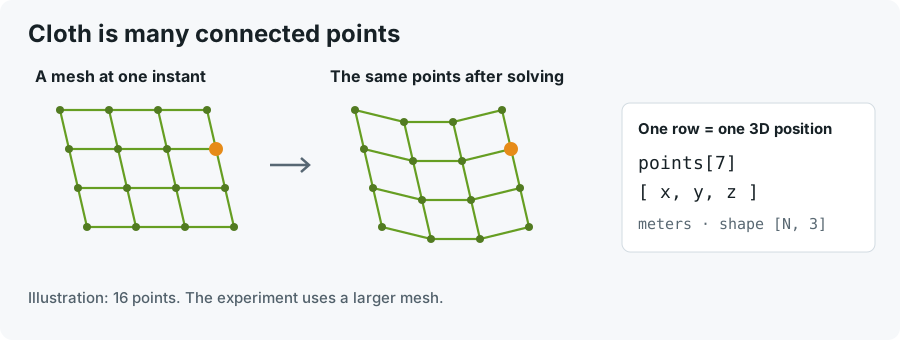
A rigid box can be described by a position and rotation. Cloth needs the positions of many connected vertices. Newton advances those positions under forces and solves constraints such as stretching, bending and contact. XPBD and VBD use different solving methods; the official examples also configure different materials and substeps, so these runs illustrate behavior rather than rank solver quality. Official cloth example · Cable twist example
| Data | Example from this experiment | Meaning |
|---|---|---|
| Cloth grid | --width 64 --height 32 |
Resolution arguments for the official example. |
| Render mesh positions | points.shape = [2145, 3] |
One XYZ position in meters per rendered vertex. |
| Moving particle positions | positions.shape = [2112, 3] |
The exported moving-particle array; it does not have the same count as the complete render mesh. |
| Animation | 240 stored samples over 4 seconds |
Recorded solver states that the GUI can revisit. |
| Cable center positions | [192, 3] |
Center-of-mass positions for cable bodies in the exported scene. |
For example, a row [0.2, 1.3, 0.8] means a point is 0.2 m along X, 1.3 m along Y and 0.8 m above the Z origin. Changing the next row of animation time moves that point; it is not a color value or a robot action. This row is an explanatory example, while the full run measurements are in recorded.json.
What does the video show?
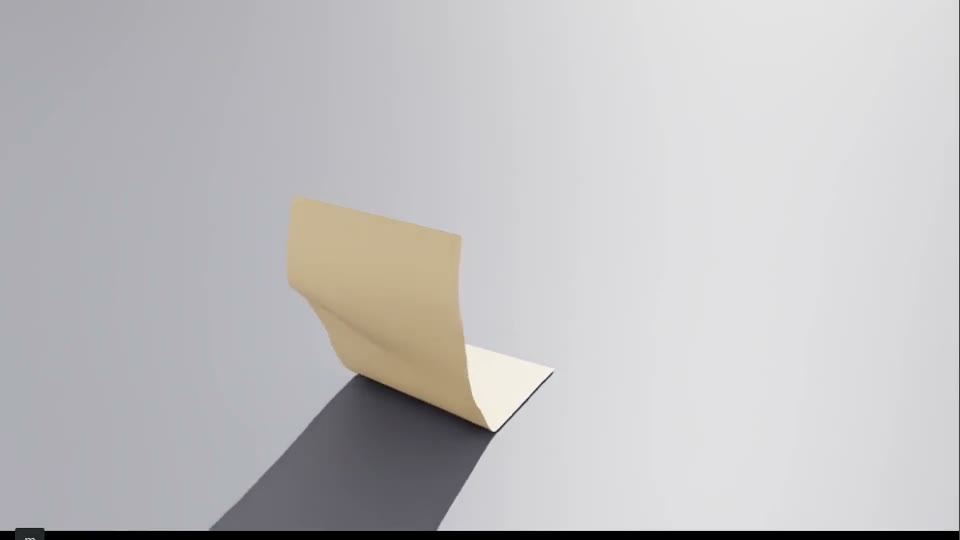
Newton computes the motion on the GPU and writes time-sampled OpenUSD. Isaac Sim opens that file and displays the recorded states. The capture is the actual Isaac Sim viewport, cropped from the application window. The solver is Newton; this GUI recording is a replay, with a playback speed of 0.65× and a short hold at the end. Shots appear in the order XPBD cloth, VBD cloth and cable twist. The three cable variants use the official example’s different stiffness values.
First time? Get the lab files
Open a terminal on the Isaac Sim machine for GPU labs, or on your own computer for CPU-only steps. Press Enter after each line. You can copy a multi-line command block as a whole.
cd "$HOME"
git clone https://github.com/james-joobs/awesome-nvidia-physical-ai.git
cd awesome-nvidia-physical-ai
pwd
This example clones into your home folder. If you already cloned the repo, skip git clone and enter your project folder. In each new terminal, check that pwd ends in awesome-nvidia-physical-ai so commands can find the labs/ files.
Run it
Prepare the Python environment
Use Linux with an NVIDIA GPU and a Newton environment that includes its examples, NumPy and usd-core. These runs used Newton 1.9.0.dev0 and Warp 1.17.0. The API of a different Newton version can change; check python -m newton.examples cloth_hanging --help first. Newton examples
Open a terminal in this repository. Replace the Python path below with the Python inside your Newton environment. The first command checks the environment; the second computes all three cases and saves them to a new folder.
python3 labs/cli.py --json doctor newton-materials --python /path/to/newton-env/bin/python
python3 labs/cli.py --json run newton-materials \
  --python /path/to/newton-env/bin/python --output ./runs/newton-materials-001
python3 labs/cli.py --json verify ./runs/newton-materials-001
Watch the motion in Isaac Sim
In File → Open, open a *-review.usda file from your output folder and choose FilmCamera in the viewport. Keep the referenced .usd next to it. Drag the timeline to inspect the deformation. Use the script below to record the actual application window on an X11 desktop. Here python must belong to your Isaac Lab environment; it can be a different environment from Newton.
python labs/physics/capture_gui.py ./runs/newton-materials-001 ./runs/newton-gui-001 \
  /path/to/ffmpeg --plan ./runs/newton-materials-001/takes.json --viz kit
The recorded GUI environment was Isaac Sim 6.1.0.0, launched through Isaac Lab. GUI setup · CLI reference
Check the result
The run fails if an official --test command fails, point arrays contain NaN/Inf, or no animated points are found. result.json includes the official example source hashes, array shapes, displacement and time range. The maximum stored-vertex displacements were about 5.06 m for XPBD cloth and 4.28 m for VBD cloth in this setup. They show deformation, not accuracy scores.
run.json stores command and artifact hashes. verify checks these again. capture.json separately records the GUI version and captured takes. Keep solver success and successful GUI capture as separate checks: one does not guarantee the other. Physics and contact experiments · Newton principles
Example run and recording
Source code
run.py
View files on GitHub"""Run official Newton material examples and prepare USD scenes for GUI review.
Requires Newton's example dependencies, numpy and usd-core in this interpreter.
The generated USD contains recorded solver states; Isaac Sim displays a replay.
"""
import argparse
import hashlib
import importlib
import json
from pathlib import Path
import subprocess
import sys
import time
import newton
import numpy as np
import warp
from pxr import Gf, Usd, UsdGeom, UsdLux
CASES = {
"cloth-xpbd": ("cloth_hanging", ["--solver", "xpbd", "--width", "64", "--height", "32"],
"newton.examples.cloth.example_cloth_hanging"),
"cloth-vbd": ("cloth_hanging", ["--solver", "vbd", "--width", "64", "--height", "32"],
"newton.examples.cloth.example_cloth_hanging"),
"cable-twist": ("cable_twist", [], "newton.examples.cable.example_cable_twist"),
}
def inspect_and_frame(path, name):
stage = Usd.Stage.Open(str(path))
if not stage or stage.GetEndTimeCode() <= stage.GetStartTimeCode():
raise RuntimeError(f"No animated USD: {path}")
low, high = np.full(3, np.inf), np.full(3, -np.inf)
animated = []
for prim in stage.Traverse():
for attribute_name in ("points", "positions"):
attribute = prim.GetAttribute(attribute_name)
if not attribute or len(attribute.GetTimeSamples()) < 2:
continue
times = attribute.GetTimeSamples()
samples = [np.asarray(attribute.Get(t), dtype=float) for t in (times[0], times[len(times)//2], times[-1])]
if not all(array.ndim == 2 and array.shape[1] == 3 and np.isfinite(array).all() for array in samples):
raise RuntimeError(f"Invalid point data: {prim.GetPath()}")
nonempty = [array for array in samples if len(array)]
if not nonempty:
continue
low = np.minimum(low, np.concatenate(nonempty).min(axis=0))
high = np.maximum(high, np.concatenate(nonempty).max(axis=0))
same_shape = samples[0].shape == samples[-1].shape
displacement = float(np.max(np.linalg.norm(samples[-1] - samples[0], axis=1))) if same_shape and len(samples[0]) else None
animated.append({"prim": str(prim.GetPath()), "attribute": attribute_name,
"first_shape": list(samples[0].shape), "time_samples": len(times),
"max_displacement_m": displacement})
if not animated or not np.isfinite(low).all():
raise RuntimeError("No animated point arrays to verify")
# A separate camera layer leaves the official solver output intact.
review = Usd.Stage.CreateNew(str(path.parent / f"{name}-review.usda"))
review.GetRootLayer().subLayerPaths = [path.name]
review.SetStartTimeCode(stage.GetStartTimeCode())
review.SetEndTimeCode(stage.GetEndTimeCode())
review.SetTimeCodesPerSecond(stage.GetTimeCodesPerSecond())
UsdGeom.SetStageUpAxis(review, UsdGeom.Tokens.z)
UsdGeom.SetStageMetersPerUnit(review, 1.0)
world = UsdGeom.Xform.Define(review, "/World")
review.SetDefaultPrim(world.GetPrim())
center = (low + high)/2
radius = max(1.0, float(np.linalg.norm(high-low)))
eye = center + np.array([0.8, -1.25, 0.65])*radius*1.3
camera = UsdGeom.Camera.Define(review, "/World/FilmCamera")
look = Gf.Matrix4d().SetLookAt(Gf.Vec3d(*eye), Gf.Vec3d(*center), Gf.Vec3d(0,0,1))
UsdGeom.Xformable(camera).AddTransformOp().Set(look.GetInverse())
camera.CreateFocalLengthAttr(36)
camera.CreateHorizontalApertureAttr(36)
camera.CreateVerticalApertureAttr(20.25)
camera.CreateClippingRangeAttr(Gf.Vec2f(0.01, radius*100))
dome = UsdLux.DomeLight.Define(review, "/World/DomeLight")
dome.CreateIntensityAttr(650)
sun = UsdLux.DistantLight.Define(review, "/World/Sun")
sun.CreateIntensityAttr(2000)
UsdGeom.Xformable(sun).AddRotateXYZOp().Set(Gf.Vec3f(315, 20, 35))
review.GetRootLayer().Save()
return {"animated_arrays": animated, "bounds_m": [low.tolist(), high.tolist()],
"simulated_seconds": (stage.GetEndTimeCode()-stage.GetStartTimeCode()) / stage.GetTimeCodesPerSecond(),
"review_scene": f"{name}-review.usda"}
def main():
parser = argparse.ArgumentParser(description=__doc__)
parser.add_argument("output", type=Path)
parser.add_argument("--cases", nargs="+", choices=list(CASES), default=list(CASES))
parser.add_argument("--frames", type=int, default=240)
args = parser.parse_args()
if args.frames < 60:
parser.error("Use at least 60 frames for a meaningful material experiment")
args.output.mkdir(parents=True, exist_ok=True)
report = {"engine": "Newton", "version": newton.__version__, "warp": warp.__version__,
"recording_mode": "solver-usd-replay", "cases": []}
plan = []
for name in args.cases:
example, parameters, module_name = CASES[name]
path = args.output.resolve() / f"{name}.usd"
if path.exists():
raise FileExistsError(path)
command = [sys.executable, "-m", "newton.examples", example, *parameters,
"--device", "cuda:0", "--viewer", "usd", "--output-path", str(path),
"--num-frames", str(args.frames), "--test"]
source = Path(importlib.import_module(module_name).__file__)
start = time.monotonic()
with (args.output / f"{name}.log").open("w") as log:
subprocess.run(command, stdout=log, stderr=subprocess.STDOUT, check=True)
row = {"case": name, "command": command, "official_tests_passed": True,
"source_sha256": hashlib.sha256(source.read_bytes()).hexdigest(),
"wall_seconds": round(time.monotonic()-start, 2), **inspect_and_frame(path, name)}
report["cases"].append(row)
plan.append([name, f"{name}-review", "FilmCamera", 0, 0.65, 8])
print(json.dumps(row), flush=True)
(args.output / "result.json").write_text(json.dumps(report, indent=2) + "\n")
(args.output / "takes.json").write_text(json.dumps(plan, indent=2) + "\n")
if __name__ == "__main__":
main()