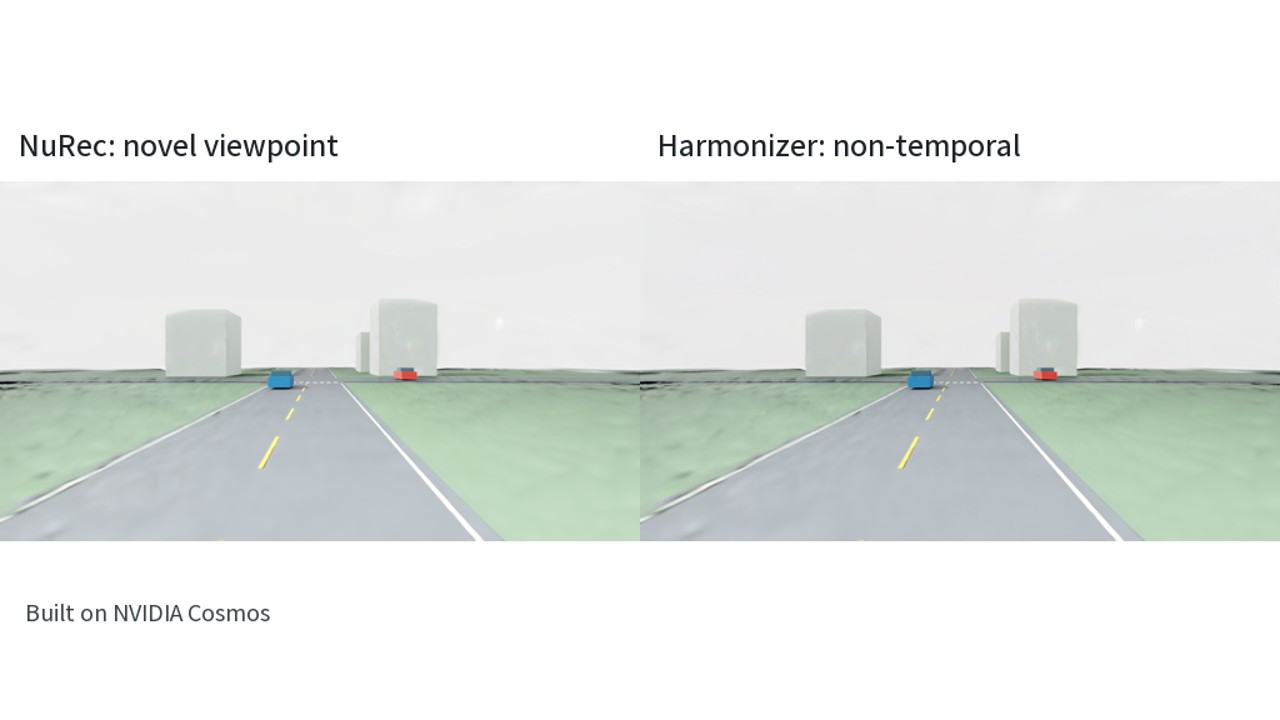
Move a camera above a road we built, reconstruct that view with NuRec, compare Harmonizer’s output, and draw Alpamayo 2 Edge’s predicted route. Start with the saved results on a CPU; the GPU steps regenerate them. This is a static-scene rendering experiment plus one driving-model prediction.
How it works
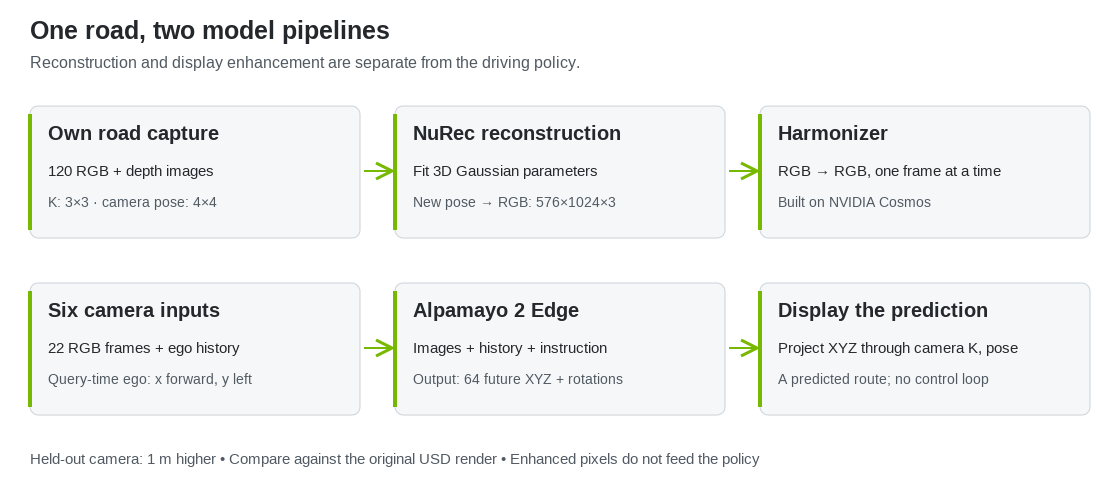
- InputCapture our road
120 RGB + z-depth images · K · camera-to-worldOnly training-view depth seeds the Gaussian model. Keep 40 elevated camera views for comparison.
- ProcessReconstruct and enhance
NuRec novel RGB → non-temporal Harmonizer RGBCompare against the original USD. A learned enhancement can reduce pixel fidelity.
- OutputShow a predicted route
Six raw cameras + ego history → 64 future posesProject the actual Alpamayo output onto the display. This does not apply vehicle controls.
1. Why capture images, depth and camera poses?
An image stores colors, but does not by itself tell us where the camera or road is in 3D. Our primitive-only USD road gives us known geometry. Isaac Sim captures 120 RGB images and z-depth maps along three parallel camera tracks. Each RGB image has shape 576 × 1024 × 3, with uint8 values from 0 to 255. Depth is a 576 × 1024 floating-point array in meters measured along the optical axis.
The camera matrix is:
K = [[512,   0, 512],
     [  0, 512, 288],
     [  0,   0,   1]]
512 is the focal length in pixels; (512, 288) is the principal point. A 4 × 4 camera-to-world matrix places the camera in the scene. OpenCV/NCore camera coordinates point right, down and forward; USD cameras point along -Z with +Y up. The capture script explicitly changes that basis.
To turn a depth pixel into a point, compute X = (u-cx)·Z/fx and Y = (v-cy)·Z/fy, then transform (X,Y,Z) into world coordinates. We use only training-view depth to seed 90,028 Gaussians. This uses simulator ground truth; it does not test recovery of geometry from ordinary monocular video. The adapter packages RGB, intrinsics, transforms, timestamps and empty static-scene tracks as NCore V4. NCore conventions
2. What does NuRec learn, and what makes a view new?
NuRec fits Gaussian positions, scale, rotation, opacity and color so the rendered training views match the captured images. A requested camera pose and calibration then produce a new RGB image. This run uses NuRec 26.04, 2,400 training steps and the gsplat renderer. A separate 40-pose path moves the camera 1 m higher, between the training tracks. Its RGB and depth do not enter fitting or initialization. We render the original USD from the same 40 poses to obtain a reference.
A Gaussian scene describes appearance. It does not supply vehicle dynamics, colliders or a controller. NuRec source and distribution
3. What does Harmonizer change?
The published harmonizer_nontemporal.pt checkpoint takes float[1,3,1,576,1024] RGB normalized to [-1,1] and produces an image of the same shape. It runs a learned, single-step enhancement based on Cosmos. Our runner converts the output back to RGB PNG without an extra color-transfer pass.
This is non-temporal inference: each image is independent. The temporal checkpoint uses previous enhanced frames and a separate Cosmos base model. Access to that base model was unavailable in this run, so no temporal result is claimed. Harmonizer model card · Official integration
Built on NVIDIA Cosmos. Pixel changes can smooth an artifact or alter a lane edge. We compare against the original USD rather than treating every change as an improvement.
4. Where does the green route come from?
Alpamayo receives raw Isaac Sim images from six cameras, not the Harmonizer output. There are 22 images with camera IDs and timestamps, 20 past ego positions and rotations, and the instruction Continue straight through the intersection. The policy branch and display branch share the same road scene.
image_frames:    uint8[22,1,3,360,640]
ego_history_xyz: float[1,20,3]
ego_history_rot: float[1,20,3,3]
          ↓ Alpamayo 2 Edge
pred_xyz:        float[1,1,1,64,3]
pred_rot:        float[1,1,1,64,3,3]
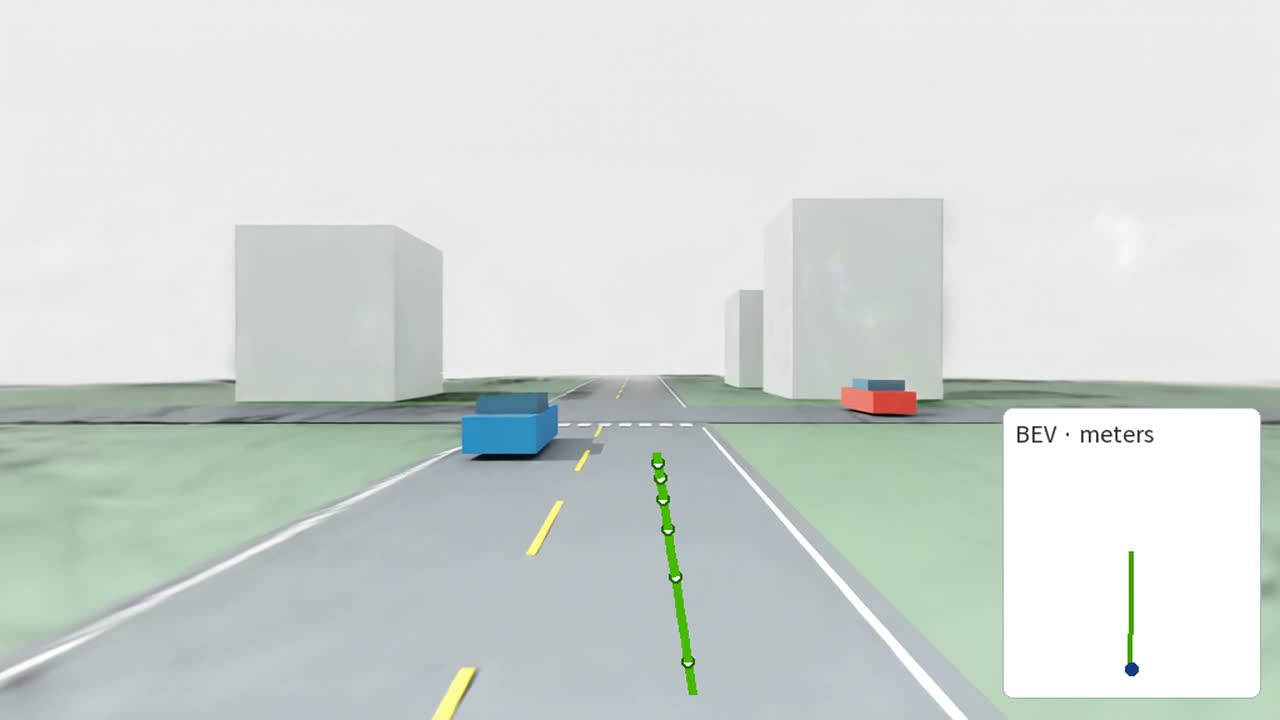
The 64 future poses cover 6.4 seconds at 0.1-second intervals. The actual first predicted point is approximately [0.5010, 0.000064, 0.0] m; the last is [30.2868, -0.08339, 0.0] m. These are relative to the ego vehicle at query time: x forward, y left, z up. The compositor places that origin at [0,-1.8,0] in our USD world, applies the display camera’s inverse pose, and projects with K. BEV shows the complete route even where points fall outside the camera image.
The animation reveals a single saved prediction. It does not send steering commands or request fresh policy decisions after moving. The returned reasoning text is <NOMINAL>; no longer explanation is inferred. Alpamayo 2 Edge
First time? Get the lab files
Open a terminal on the NVIDIA GPU machine for GPU labs, or on your own computer for CPU-only steps. Press Enter after each line. You can copy a multi-line command block as a whole.
cd "$HOME"
git clone https://github.com/james-joobs/awesome-nvidia-physical-ai.git
cd awesome-nvidia-physical-ai
pwd
This example clones into your home folder. If you already cloned the repo, skip git clone and enter your project folder. In each new terminal, check that pwd ends in awesome-nvidia-physical-ai so commands can find the labs/ files.
Run the lab
1. Inspect the saved example without a GPU
Open the English comparison video, or inspect NuRec alone, Harmonizer alone and the route overlay. The three lossless image triplets and trajectory JSON are in evidence.
For numerical checks, open a terminal in the repository folder. A small Python environment keeps these CPU dependencies separate from GPU frameworks:
python3 -m venv .venv-reality-check
source .venv-reality-check/bin/activate
python -m pip install numpy Pillow
python labs/reality-view/check.py
The checker verifies file hashes, 64 finite poses, rotation matrices and the PSNR of the saved image triplets. Add --decode-video after installing FFmpeg to decode every MP4 and detect damaged frames.
2. Prepare the GPU machine and model environment
Use an NVIDIA Linux machine with Docker GPU access, an Isaac Lab Python environment and at least 40 GB of free disk space. This small preset ran on RTX 5090 32 GB, host RAM about 32 GB, Isaac Sim 6.1.0.0 / Isaac Lab 17.0.2. NuRec recommends more host RAM for general reconstruction workloads; this preset reduces data-loader workers and uses a small static scene. Preserve the tested runtime rather than upgrading it in place. Linux GPU onboarding · Isaac Sim onboarding · NuRec hardware requirements
Run these commands in the repository’s terminal on that machine. Replace the Python path with the executable from your Isaac Lab installation:
export REALITY_VIEW_ROOT="$HOME/physical-ai-labs/road-view"
export ALPAMAYO_ROOT="$HOME/physical-ai-labs/road-models"
export ISAAC_PYTHON="/absolute/path/to/isaaclab/.venv/bin/python"
mkdir -p "$REALITY_VIEW_ROOT" "$ALPAMAYO_ROOT"
nvidia-smi
The variables select output/model folders; they do not contain a server address or credential. Confirm the GPU is free before starting. Install uv and authenticate with Hugging Face if required by your account, then download the pinned models:
bash labs/reality-view/setup_models.sh
docker pull nvcr.io/nvidia/nre/nre-ga:26.04
The runner pins the verified container digest in run.sh. NuRec’s runtime terms, Harmonizer’s NVIDIA Open Model License and Alpamayo weights’ OpenMDW-1.1 are separate from this repository’s MIT code license. We do not redistribute model weights. Pins and official licenses
3. Capture the road and convert its data
After reviewing the Omniverse license, set its acceptance variable for the simulator. capture opens our USD and writes the images/calibration; prepare creates NCore and the Gaussian seed.
export OMNI_KIT_ACCEPT_EULA=YES
bash labs/reality-view/run.sh capture
bash labs/reality-view/run.sh prepare
Expect CAPTURE complete: 120 training, 40 held-out, 22 policy frames, then prepared.json and ncore/own-road.json. Use a fresh output folder for a new attempt; the NCore writer expects new component groups. The historical camera ID camera_front_wide_120fov is an integration identifier; the actual camera here is a 90° pinhole, as recorded in its intrinsics.
4. Fit NuRec, render the elevated camera, then run Harmonizer
bash labs/reality-view/run.sh train
bash labs/reality-view/run.sh render
bash labs/reality-view/run.sh enhance
Training creates train/<run-id>/artifacts/last.usdz. Rendering uses novel-rig.json, with the same poses as the held-out USD reference, and explicitly selects --renderer gsplat. The 26.04 default renderer stalled on this artifact during our attempt. Successful output is 40 PNGs in novel/, followed by 40 PNGs in enhanced/ and harmonizer-result.json.
The standalone TorchScript runner needs the Transformer Engine operations supplied by this NuRec image. It preserves the checkpoint’s original device placement: forcing all frozen constants onto CUDA caused a device mismatch in our initial test.
5. Run the driving model and make your own videos
bash labs/reality-view/run.sh policy
Wait for alpamayo/output.safetensors and alpamayo/receipt.json. The wrapper verifies both model shards against the pinned SHA-256 digests. It uses the repository’s existing Alpamayo runner.
On a CPU environment with NumPy, Pillow and FFmpeg, run the compositor with a font that contains Korean glyphs:
python labs/reality-view/package.py \
  --input "$REALITY_VIEW_ROOT" \
  --output "$REALITY_VIEW_ROOT/published" \
  --font /absolute/path/to/NotoSansKR.ttf
This writes English/Korean 20-second comparison videos, separate NuRec/Harmonizer/route clips, lossless frame samples and measurement JSON. The film uses edited playback speed; it does not represent real-time model throughput.
Verify the result
| Check | Measured in this run | Interpretation |
|---|---|---|
| NuRec fitting | 2,400 steps, 67.42 s | Training-loop time, not complete setup time |
| Held-out NuRec / Harmonizer PSNR | 29.21 / 27.09 dB, 40 aligned views | Enhancement reduced pixel fidelity on this simple synthetic scene |
| Non-temporal Harmonizer | 0.1285 s/frame median after the first; first frame 12.55 s | GPU forward time with synchronization; excludes image I/O and loading |
| Alpamayo | 23.43 s including loading/input handling; 19.24 s reported by run_data |
One prediction, unsuitable for a real-time claim |
| Alpamayo peak PyTorch allocation | 5.76 GiB | Excludes some driver/runtime memory; not total GPU use |
| Future poses | 64 finite XYZ/rotation pairs | Interface check, not driving safety or collision evaluation |
Inspect lane edges, object boundaries and newly revealed ground. Whole-frame PSNR also includes large simple sky/ground regions; it is not a perception or policy score. Keep the lower Harmonizer score visible when discussing this run.
The original USD, complete captures and trained NuRec artifact remain in the local output folder. The repository includes lightweight videos, nine lossless sample images, the 64-pose JSON and measured receipt. No NVIDIA driving dataset or pretrained checkpoint is bundled.
Next: NuRec principles · Alpamayo principles · AlpaSim closed-loop evaluation. Closing the loop requires new rendered sensor observations after each applied control step, plus separate collision and off-road evaluation.
Example run and recording
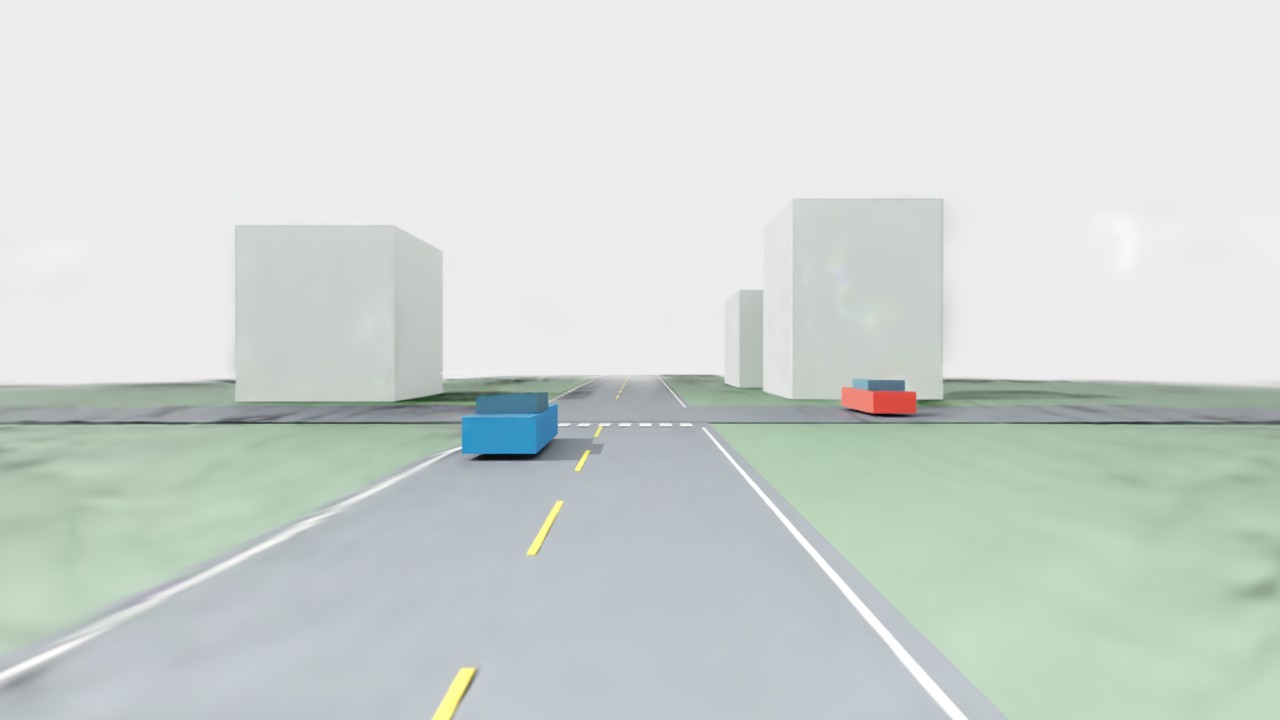
NuRec novel-camera sweep
Forty held-out camera poses, 1 m higher than capture. This is the neural render before enhancement.
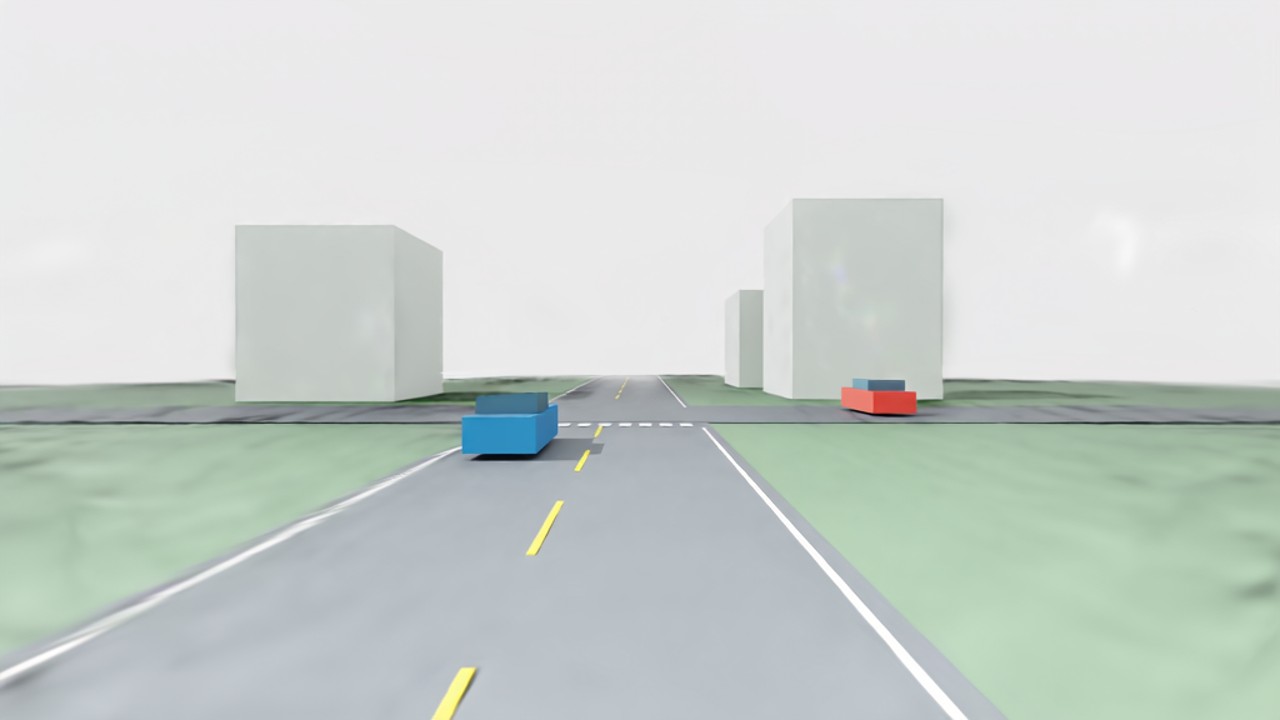
Harmonizer on the same camera sweep
The released non-temporal checkpoint processes each frame independently. Built on NVIDIA Cosmos.
The actual 64-pose prediction
One Alpamayo output projected onto the display camera and BEV. No controls or new decisions are applied.
Source code
setup_models.sh
View files on GitHub#!/usr/bin/env bash
set -euo pipefail
model_root="${ALPAMAYO_ROOT:?Choose a separate folder for model code, environment and weights}"
task_root="${REALITY_VIEW_ROOT:?Choose the task output folder}"
uv_bin="${UV_BIN:-uv}"
mkdir -p "$model_root" "$task_root/checkpoints/Harmonizer"
source_root="$model_root/alpamayo2-edge"
if [[ ! -d "$source_root/.git" ]]; then
git clone https://github.com/NVlabs/alpamayo2-edge.git "$source_root"
fi
if [[ -n "$(git -C "$source_root" status --porcelain)" ]]; then
printf '%s\n' 'The Alpamayo checkout has local changes. Use a clean model folder.' >&2
exit 1
fi
git -C "$source_root" fetch origin 02f55a7aeabc1a2b9f7a80445c08e40bddc89f5e
git -C "$source_root" checkout --detach 02f55a7aeabc1a2b9f7a80445c08e40bddc89f5e
(cd "$source_root" && "$uv_bin" sync --locked --extra dataset --no-default-groups)
"$source_root/.venv/bin/hf" download nvidia/Alpamayo2-Edge \
--revision b92b6aa326bd3e2235db28f248ad5a30b5890e64 --local-dir "$model_root/checkpoints/Alpamayo2-Edge"
"$source_root/.venv/bin/hf" download nvidia/Harmonizer harmonizer_nontemporal.pt \
--revision 20ca33d4612b1e98e0526b3a7ee604af5b289f58 --local-dir "$task_root/checkpoints/Harmonizer"
run.sh
View files on GitHub#!/usr/bin/env bash
set -euo pipefail
lab_dir="$(cd -- "$(dirname -- "${BASH_SOURCE[0]}")" && pwd)"
repo_dir="$(cd -- "$lab_dir/../.." && pwd)"
task_root="${REALITY_VIEW_ROOT:?Set REALITY_VIEW_ROOT to an isolated output folder}"
mkdir -p "$task_root/runtime-home"
task_root="$(cd -- "$task_root" && pwd)"
image="nvcr.io/nvidia/nre/nre-ga:26.04@sha256:97f43e7130c5636ce3e80ea3184d97f56a87fdd989b05cce42230881dbdea284"
base=(docker run --rm --gpus all --shm-size=8g --user "$(id -u):$(id -g)"
-v "$task_root:/work" -v "$lab_dir:/lab:ro" -e REALITY_VIEW_ROOT=/work -e HOME=/work/runtime-home)
lock="${GPU_LOCK:-/tmp/physical-ai-four-domains.gpu.lock}"
case "${1:-help}" in
capture)
HEADLESS=1 flock "$lock" "${ISAAC_PYTHON:?Set ISAAC_PYTHON to your Isaac Lab Python executable}" \
"$lab_dir/capture_road.py" --scene "$repo_dir/labs/world-driving/evidence/synthetic-intersection/synthetic-intersection.usda" \
--output "$task_root/capture" --positions 40 --visualizer kit
;;
prepare)
"${base[@]}" "$image" run-script /lab/prepare_ncore.py
;;
train)
flock "$lock" "${base[@]}" -v "$lab_dir/road.yaml:/app/run.runfiles/_main/configs/reality-view.yaml:ro" \
"$image" main --config-name reality-view.yaml 2>&1 | tee "$task_root/nurec-train.log"
python3 "$lab_dir/collect_training.py"
;;
render)
python3 "$lab_dir/make_trajectory.py"
artifact="$(python3 -c 'import json,os; print(json.load(open(os.path.join(os.environ["REALITY_VIEW_ROOT"],"artifact.json")))["artifact"])')"
flock "$lock" "${base[@]}" "$image" render --artifact-path "/work/$artifact" --output-dir /work/novel \
--camera-id camera_front_wide_120fov --height 576 --renderer gsplat --custom-rig-trajectory /work/novel-rig.json \
--no-replicate-training-views --calib-source training-rig-poses --save-workers 2
;;
enhance)
flock "$lock" "${base[@]}" "$image" run-script /lab/enhance.py
;;
policy)
model_root="${ALPAMAYO_ROOT:?Set ALPAMAYO_ROOT to the folder prepared by setup_models.sh}"
flock "$lock" "$model_root/alpamayo2-edge/.venv/bin/python" "$repo_dir/labs/world-driving/run_alpamayo_synthetic.py" \
--input "$task_root/capture/policy" --model "$model_root/checkpoints/Alpamayo2-Edge" --output "$task_root/alpamayo"
;;
*) printf '%s\n' 'Choose capture, prepare, train, render, enhance, or policy. See the bilingual lab guide.'; exit 2 ;;
esac
model-pins.json
View files on GitHub{
"checked_at": "2026-11-23",
"nurec": {
"image": "nvcr.io/nvidia/nre/nre-ga:26.04",
"documentation": "https://docs.nvidia.com/nurec/",
"note": "Use the matching 26.04 CLI and nre namespace; current documentation also describes newer APIs. Runtime terms differ from the Apache-2.0 public SDK.",
"digest": "sha256:97f43e7130c5636ce3e80ea3184d97f56a87fdd989b05cce42230881dbdea284"
},
"harmonizer": {
"model": "nvidia/Harmonizer",
"revision": "20ca33d4612b1e98e0526b3a7ee604af5b289f58",
"filename": "harmonizer_nontemporal.pt",
"mode": "non-temporal; no history conditioning",
"license": "NVIDIA Open Model License",
"license_url": "https://www.nvidia.com/en-us/agreements/enterprise-software/nvidia-open-model-license/",
"source": "https://github.com/NVIDIA/harmonizer",
"source_license": "Apache-2.0",
"attribution": "Built on NVIDIA Cosmos",
"sha256": "ece8e2daa914e8c2a027a2da94e0eb2064491d5b3fd8514009fae9a442e06e90"
},
"alpamayo": {
"source": "https://github.com/NVlabs/alpamayo2-edge",
"source_revision": "02f55a7aeabc1a2b9f7a80445c08e40bddc89f5e",
"model": "nvidia/Alpamayo2-Edge",
"model_revision": "b92b6aa326bd3e2235db28f248ad5a30b5890e64",
"source_license": "Apache-2.0",
"weights_license": "OpenMDW-1.1"
},
"inputs": "Self-authored primitive-only Isaac Sim road; no PhysicalAI-AV or NuRec dataset images/artifacts."
}
capture_road.py
View files on GitHub"""Capture our primitive-only road as calibrated RGB/depth, held-out views and VLA inputs.
Run with Isaac Lab's Python, using the scene committed in this repository.
No downloaded driving scenes, textures, actors or NVIDIA dataset frames are used.
"""
import argparse
import hashlib
import json
import math
from importlib.metadata import version
from pathlib import Path
from isaaclab.app import AppLauncher
parser = argparse.ArgumentParser()
parser.add_argument('--scene', type=Path, required=True)
parser.add_argument('--output', type=Path, required=True)
parser.add_argument('--positions', type=int, default=40)
AppLauncher.add_app_launcher_args(parser)
args = parser.parse_args()
args.enable_cameras = True
launcher = AppLauncher(args)
app = launcher.app
import numpy as np
from PIL import Image
import omni.replicator.core as rep
import omni.usd
from pxr import Gf, UsdGeom
out = args.output
out.mkdir(parents=True, exist_ok=True)
omni.usd.get_context().open_stage(str(args.scene.resolve()))
for _ in range(30):
app.update()
stage = omni.usd.get_context().get_stage()
camera = UsdGeom.Camera.Get(stage, '/World/Camera')
op = camera.MakeMatrixXform()
w, h = 1024, 576
aperture = 20.955
camera.GetHorizontalApertureAttr().Set(aperture)
camera.CreateVerticalApertureAttr(aperture * h / w)
camera.GetClippingRangeAttr().Set(Gf.Vec2f(.1, 250))
product = rep.create.render_product(str(camera.GetPath()), (w, h))
rgb_reader = rep.AnnotatorRegistry.get_annotator('rgb')
depth_reader = rep.AnnotatorRegistry.get_annotator('distance_to_image_plane')
for reader in [rgb_reader, depth_reader]:
reader.attach([product])
def capture(folder, name, eye, yaw=0., focal=10.4775, depth=False):
folder.mkdir(exist_ok=True, parents=True)
target = Gf.Vec3d(*eye) + Gf.Vec3d(30 * math.cos(yaw), 30 * math.sin(yaw), -.2)
matrix = Gf.Matrix4d(1).SetLookAt(Gf.Vec3d(*eye), target, Gf.Vec3d(0, 0, 1)).GetInverse()
op.Set(matrix)
camera.GetFocalLengthAttr().Set(focal)
for _ in range(10):
app.update()
rgb = np.asarray(rgb_reader.get_data())[:, :, :3].copy()
if rgb.shape != (h, w, 3) or rgb.mean() < 3:
raise RuntimeError('Camera returned an empty or unexpected image')
path = folder / f'{name}.png'
Image.fromarray(rgb).save(path)
# USD uses row vectors, -Z forward, +Y up. NCore/OpenCV uses +Z forward, +Y down.
c2w = np.asarray(matrix, dtype=np.float64).T @ np.diag([1., -1., -1., 1.])
K = [[focal / aperture * w, 0, w / 2], [0, focal / aperture * w, h / 2], [0, 0, 1]]
if depth:
z = np.asarray(depth_reader.get_data()).reshape(h, w).copy()
np.save(folder / f'{name}.depth.npy', z)
return {'image': str(path.relative_to(out)), 'camera_to_world': c2w.tolist(), 'K': K,
'sha256': hashlib.sha256(path.read_bytes()).hexdigest()}
train = []
for track, y in enumerate([-2.6, -1.8, -1.0]):
for i, x in enumerate(np.linspace(-14, 12, args.positions)):
row = capture(out/'train', f'{len(train):05d}', (float(x), y, 1.6), depth=True)
row['timestamp_us'] = 1_000_000 + len(train) * 100_000
train.append(row)
print(f'CAPTURE training track {track + 1}/3 completed', flush=True)
novel = []
for i, x in enumerate(np.linspace(-12, 10, args.positions)):
row = capture(out/'held-out', f'{i:05d}', (float(x), -1.4, 2.6))
row['timestamp_us'] = 1_000_000 + i * 100_000
novel.append(row)
print('CAPTURE held-out elevated camera completed', flush=True)
# Same six camera IDs/time history as the existing, pinned Alpamayo 2 Edge wrapper.
profiles = {0: (55, [-1, -.1, 0], 12), 1: (0, [-2, -1, -.5, -.1, 0], 14),
2: (-55, [-1, -.1, 0], 12), 3: (145, [-1, -.1, 0], 12),
5: (-145, [-1, -.1, 0], 12), 6: (0, [-2, -1, -.5, -.1, 0], 30)}
shots = []
policy = out/'policy'
for camera_id, (degrees, times, focal) in profiles.items():
for offset in times:
name = f'camera-{camera_id}-t{round((offset + 2)*1e6):07d}'
row = capture(policy, name, (offset * 5, -1.8, 1.6), math.radians(degrees), focal)
# Match the pre-existing smoke test resolution, without changing the scene aspect ratio.
p = out/row['image']
Image.open(p).resize((640, 360), Image.Resampling.LANCZOS).save(p)
shots.append({'camera_id': camera_id, 'timestamp_us': round((offset + 2)*1e6),
'relative_time_s': offset, 'image': p.name,
'sha256': hashlib.sha256(p.read_bytes()).hexdigest()})
manifest = {'schema': 1, 'runtime': {'isaac_sim': version('isaacsim'), 'isaac_lab': version('isaaclab')}, 'source': 'self-authored primitive-only Isaac Sim road',
'width': w, 'height': h, 'units': 'meters', 'camera_convention': 'OpenCV: x right, y down, z forward',
'world_convention': 'x road forward, y left, z up', 'train': train, 'held_out': novel,
'held_out_offset': 'elevated by 1.0 m; y=-1.4 m between capture tracks',
'scene_sha256': hashlib.sha256(args.scene.read_bytes()).hexdigest()}
(out/'capture.json').write_text(json.dumps(manifest, indent=2)+'\n')
(policy/'input.json').write_text(json.dumps({'kind': 'self-authored road; model interface experiment',
'width': 640, 'height': 360, 'ego_speed_m_s': 5, 'shots': shots,
'history_times_s': [round(-1.9+.1*i, 3) for i in range(20)],
'history_xyz_m': [[round((-1.9+.1*i)*5, 3), 0, 0] for i in range(20)]}, indent=2)+'\n')
stage.GetRootLayer().Export(str(out/'road.usda'))
for reader in [rgb_reader, depth_reader]:
reader.detach([product])
print(f'CAPTURE complete: {len(train)} training, {len(novel)} held-out, {len(shots)} policy frames', flush=True)
app.close()
prepare_ncore.py
View files on GitHub"""Convert calibrated, self-authored RGB/depth into NCore V4 and a Gaussian seed.
Run through NuRec 26.04 `run-script` with REALITY_VIEW_ROOT set to the task folder.
Depth is synthetic ground truth, not an estimated sensor measurement. This lab
therefore studies reconstruction/rendering, not monocular geometry recovery.
"""
import json
import os
from pathlib import Path
import numpy as np
from PIL import Image
from upath import UPath
from ncore.data import OpenCVPinholeCameraModelParameters, ShutterType
from ncore.data.v4 import (SequenceComponentGroupsWriter, SequenceComponentGroupsReader,
PosesComponent, IntrinsicsComponent, MasksComponent,
CameraSensorComponent, CuboidsComponent)
from ncore.impl.common.transformations import HalfClosedInterval
root = Path(os.environ['REALITY_VIEW_ROOT'])
capture = root/'capture'
meta = json.loads((capture/'capture.json').read_text())
rows = meta['train']
times = np.array([r['timestamp_us'] for r in rows], dtype=np.uint64)
output = root/'ncore'
output.mkdir(exist_ok=True)
writer = SequenceComponentGroupsWriter(UPath(output), 'own-road', 'own-road',
HalfClosedInterval.from_start_end(int(times[0]), int(times[-1])),
{'source': 'self-authored Isaac Sim road; synthetic depth and calibration'}, store_type='directory')
def register(cls, name='default'):
return writer.register_component_writer(cls.Writer, component_instance_name=name, group_name='default')
poses = register(PosesComponent)
camera_to_rig = np.array([[0,0,1,0],[-1,0,0,0],[0,-1,0,1.6],[0,0,0,1]], dtype=np.float64)
c2w = np.array([r['camera_to_world'] for r in rows], dtype=np.float64)
rigs = c2w @ np.linalg.inv(camera_to_rig)
poses.store_dynamic_pose('rig', 'world', rigs.astype(np.float32), times)
poses.store_static_pose('camera_front_wide_120fov', 'rig', camera_to_rig.astype(np.float32))
poses.store_static_pose('world', 'world_global', np.eye(4, dtype=np.float64))
K = np.array(rows[0]['K'])
intrinsics = register(IntrinsicsComponent)
intrinsics.store_camera_intrinsics('camera_front_wide_120fov', OpenCVPinholeCameraModelParameters(
resolution=np.array([meta['width'], meta['height']], dtype=np.uint64),
shutter_type=ShutterType.GLOBAL, principal_point=K[:2,2].astype(np.float32),
focal_length=np.array([K[0,0],K[1,1]],dtype=np.float32), radial_coeffs=np.zeros(6,dtype=np.float32),
tangential_coeffs=np.zeros(2,dtype=np.float32), thin_prism_coeffs=np.zeros(4,dtype=np.float32)))
# This name follows AlpaSim/NuRec conventions; actual intrinsics here are 90° pinhole, not 120°.
register(MasksComponent).store_camera_masks('camera_front_wide_120fov', {})
register(CuboidsComponent).store_observations([])
frames = register(CameraSensorComponent, 'camera_front_wide_120fov')
for row in rows:
t = row['timestamp_us']
frames.store_frame(image_binary_data=(capture/row['image']).read_bytes(), image_format='png',
frame_timestamps_us=np.array([t,t],dtype=np.uint64), generic_data={}, generic_meta_data={})
paths = writer.finalize()
reader = SequenceComponentGroupsReader(paths)
(output/'own-road.json').write_text(json.dumps(reader.get_sequence_meta().to_dict(),indent=2)+'\n')
# Back-project rendered z-depth using pixel centers and known OpenCV camera transforms.
points, colors = [], []
for row in rows[::3]:
path = capture/row['image']
z = np.load(path.with_suffix('.depth.npy'))
rgb = np.array(Image.open(path).convert('RGB'))
yy, xx = np.mgrid[0:meta['height']:8, 0:meta['width']:8]
depth = z[yy,xx]
valid = np.isfinite(depth) & (depth>.2) & (depth<100)
p = np.stack([(xx+.5-K[0,2])/K[0,0]*depth, (yy+.5-K[1,2])/K[1,1]*depth, depth],axis=-1)[valid]
c = np.array(row['camera_to_world'])
points.append(p@c[:3,:3].T+c[:3,3]); colors.append(rgb[yy,xx][valid]/255.)
p = np.concatenate(points); c = np.concatenate(colors)
_, keep = np.unique(np.floor(p/.10).astype(np.int64), axis=0, return_index=True)
p,c = p[keep],c[keep]
fields = [(n,'f4') for n in ['x','y','z','nx','ny','nz','f_dc_0','f_dc_1','f_dc_2','opacity','scale_0','scale_1','scale_2','rot_0','rot_1','rot_2','rot_3']]
v = np.zeros(len(p), dtype=fields)
for i,n in enumerate(['x','y','z']):v[n]=p[:,i]
for i in range(3):v[f'f_dc_{i}']=(c[:,i]-.5)/.28209479177387814; v[f'scale_{i}']=np.log(.075)
v['opacity']=1.;v['rot_0']=1.
header = 'ply\nformat binary_little_endian 1.0\nelement vertex '+str(len(v))+'\n'+'\n'.join('property float '+n for n in v.dtype.names)+'\nend_header\n'
with (root/'seed.ply').open('wb') as stream:
stream.write(header.encode('ascii')); stream.write(v.tobytes())
report={'train_views':len(rows),'held_out_views':len(meta['held_out']),'seed_gaussians':len(p),
'seed_source':'back-projected synthetic z-depth; 0.10 m voxel subset',
'intrinsics':K.tolist(),'camera_to_rig':camera_to_rig.tolist(),
'camera_fov_degrees':90,'ncore_camera_id':'camera_front_wide_120fov',
'camera_id_note':'schema-compatible identifier; the actual calibration is 90-degree pinhole'}
(root/'prepared.json').write_text(json.dumps(report,indent=2)+'\n')
print('PREPARED',json.dumps(report),flush=True)
collect_training.py
View files on GitHub"""Extract observed NuRec timing and configuration from a completed local run."""
import json
import os
from pathlib import Path
import re
root=Path(os.environ['REALITY_VIEW_ROOT'])
log=(root/'nurec-train.log').read_text(errors='replace')
steps=re.findall(r'Number of training steps:\s*(\d+)',log)
timing=re.findall(r'Train elapsed time:\s*([\d.]+) seconds',log)
artifacts=list((root/'train').rglob('last.usdz'))
if not steps or not timing or len(artifacts)!=1:
raise RuntimeError('A complete training log and exactly one last.usdz are required')
(root/'nurec-result.json').write_text(json.dumps({
'runtime':'26.4.149','image':'nvcr.io/nvidia/nre/nre-ga:26.04',
'renderer':'gsplat','training_steps':int(steps[-1]),'training_seconds':float(timing[-1]),
'timing_scope':'NuRec-reported training elapsed time; excludes environment setup and data preparation',
'artifact_bytes':artifacts[0].stat().st_size,
},indent=2)+'\n')
print('Collected completed NuRec training metadata')
road.yaml
View files on GitHub# Self-authored RGB + synthetic depth seed, fitted by NuRec 26.04.
# The camera ID is a schema name; capture.json contains the actual 90-degree calibration.
defaults:
- /experimental/3dgut/3dgut_colmap
- override /model/gaussians/initialization@model.layers.background.initialization: ply
- _self_
out_dir: /work/train
mode: trainval
dataset:
path: /work/ncore/own-road.json
camera_ids: [camera_front_wide_120fov]
lidar_ids: []
n_samples_per_epoch: 2400
n_val_image_subsample: 2
train_sequential_camera_frame_step: 1
val_camera_frame_step: 12
camera_mask_sources: [dataset]
datamodule:
train_num_workers: 2
val_num_workers: 1
test_num_workers: 1
trainer:
max_epochs: 1
log_every_n_steps: 100
model:
layers:
background:
initialization:
path: /work/seed.ply
translate_world_to_nre: true
strategy:
add:
max_n_gaussians: 200000
system:
test:
video_fps: 10
metrics:
cpsnr:
enabled: false
make_trajectory.py
View files on GitHub"""Replace a NuRec artifact's capture path with our held-out calibrated camera poses."""
import copy
import json
import os
from pathlib import Path
import zipfile
import numpy as np
root = Path(os.environ['REALITY_VIEW_ROOT'])
artifacts = list((root/'train').rglob('last.usdz'))
if len(artifacts) != 1:
raise RuntimeError(f'Expected one completed NuRec artifact, found {len(artifacts)}')
artifact = artifacts[0]
with zipfile.ZipFile(artifact) as archive:
name = next(n for n in archive.namelist() if n.endswith('rig_trajectories.json'))
rig = json.loads(archive.read(name))
rows = json.loads((root/'capture/capture.json').read_text())['held_out']
template = copy.deepcopy(rig['rig_trajectories'][0])
sensor = next(iter(template['cameras_frame_timestamps_us']))
times = [r['timestamp_us'] for r in rows]
c2r = np.array(json.loads((root/'prepared.json').read_text())['camera_to_rig'])
poses = np.array([r['camera_to_world'] for r in rows]) @ np.linalg.inv(c2r)
template['cameras_frame_timestamps_us'] = {sensor: [[t,t] for t in times]}
template['lidars_frame_timestamps_us'] = {}
template['T_rig_worlds'] = poses.tolist()
template['T_rig_world_timestamps_us'] = times
if 'cameras_frame_T_rig_worlds' in template:
template['cameras_frame_T_rig_worlds'] = {sensor: np.repeat(poses[:,None],2,axis=1).tolist()}
if 'cameras_linear_start_frame_indices' in template:
template['cameras_linear_start_frame_indices'] = {sensor:0}
if 'lidars_linear_start_frame_indices' in template:
template['lidars_linear_start_frame_indices'] = {}
rig['rig_trajectories'] = [template]
(root/'novel-rig.json').write_text(json.dumps(rig,indent=2)+'\n')
# Store only a task-relative name. A public receipt must not carry machine paths.
(root/'artifact.json').write_text(json.dumps({'artifact':str(artifact.relative_to(root)),
'novel_views':len(rows),'sensor_id':sensor},indent=2)+'\n')
print(f'NOVEL_TRAJECTORY prepared {len(rows)} calibrated poses',flush=True)
enhance.py
View files on GitHub"""Run the official, non-temporal Harmonizer TorchScript checkpoint on NuRec frames.
Built on NVIDIA Cosmos. Model weights are obtained separately under the NVIDIA
Open Model License. This is per-frame inference; no temporal coherence is claimed.
Run inside the pinned NuRec runtime, which provides the required TE custom ops.
"""
import hashlib
import json
import os
from pathlib import Path
import time
import numpy as np
from PIL import Image
import torch
import transformer_engine # registers tex_ts::* TorchScript operations
root = Path(os.environ['REALITY_VIEW_ROOT'])
source = root/'novel'
target = root/'enhanced'
target.mkdir(exist_ok=True)
checkpoint = root/'checkpoints/Harmonizer/harmonizer_nontemporal.pt'
with checkpoint.open('rb') as stream:
checkpoint_digest = hashlib.file_digest(stream, 'sha256').hexdigest()
if checkpoint_digest != 'ece8e2daa914e8c2a027a2da94e0eb2064491d5b3fd8514009fae9a442e06e90':
raise ValueError('Harmonizer checkpoint differs from the pinned revision')
# Preserve the original placement of frozen CPU constants and CUDA weight tensors.
# Forcing map_location='cuda' also moves shape/timestep constants and breaks the trace.
model = torch.jit.load(str(checkpoint)).eval().cuda()
files = sorted(source.rglob('*.png'))
if not files:
raise RuntimeError('Render the novel-view sequence before running Harmonizer')
latencies = []
torch.cuda.reset_peak_memory_stats()
for i, path in enumerate(files):
rgb = np.array(Image.open(path).convert('RGB').resize((1024,576)))
x = torch.from_numpy(rgb.copy()).permute(2,0,1)[None,:,None].cuda().float()/127.5-1
torch.cuda.synchronize()
start = time.perf_counter()
with torch.inference_mode(), torch.amp.autocast('cuda', enabled=False):
y = model(x)
torch.cuda.synchronize()
latency = time.perf_counter()-start
if not torch.isfinite(y).all():
raise RuntimeError('Harmonizer produced nonfinite values')
if y.ndim == 5:y=y[:,:,0]
if tuple(y.shape) != (1,3,576,1024):
raise RuntimeError(f'Unexpected output shape: {list(y.shape)}')
result = ((y[0].float().permute(1,2,0).cpu().numpy()+1)*127.5).clip(0,255).astype('uint8')
Image.fromarray(result).save(target/path.name)
latencies.append(latency)
if i%10==0:print(f'HARMONIZER frame {i+1}/{len(files)}: {latency:.3f} s',flush=True)
receipt={'mode':'non-temporal single-frame; no previous-frame conditioning',
'model_id':'nvidia/Harmonizer','model_revision':'20ca33d4612b1e98e0526b3a7ee604af5b289f58',
'checkpoint':'harmonizer_nontemporal.pt','checkpoint_sha256':checkpoint_digest,
'frames':len(files),'resolution':[1024,576],'per_frame_seconds':latencies,
'median_seconds_excluding_first':float(np.median(latencies[1:])) if len(files)>1 else latencies[0],
'peak_allocated_gib':torch.cuda.max_memory_allocated()/2**30,
'torch':torch.__version__,'transformer_engine':transformer_engine.__version__,
'attribution':'Built on NVIDIA Cosmos','weights_license':'NVIDIA Open Model License'}
(root/'harmonizer-result.json').write_text(json.dumps(receipt,indent=2)+'\n')
print('HARMONIZER completed',flush=True)
package.py
View files on GitHub"""Build videos, matched-frame measurements and a small, inspectable evidence bundle.
CPU only. Requires numpy, Pillow and ffmpeg. Model inference is never replaced by
this compositor: it only reads the outputs of completed NuRec/Harmonizer/Alpamayo jobs.
"""
import argparse
import hashlib
import json
import math
from pathlib import Path
import struct
import subprocess
import numpy as np
from PIL import Image, ImageDraw, ImageFont
parser=argparse.ArgumentParser()
parser.add_argument('--input',type=Path,required=True)
parser.add_argument('--output',type=Path,required=True)
parser.add_argument('--font',type=Path,required=True,help='Font with Korean glyphs, e.g. Noto Sans CJK')
args=parser.parse_args()
r=args.input;out=args.output;out.mkdir(parents=True,exist_ok=True)
meta=json.loads((r/'capture/capture.json').read_text())
raw=sorted((r/'novel').rglob('*.png'))
enhanced=sorted((r/'enhanced').glob('*.png'))
reference=[r/'capture'/row['image'] for row in meta['held_out']]
assert len(raw)==len(enhanced)==len(reference)==40
def image(path):return Image.open(path).convert('RGB')
def sha(path):
with path.open('rb') as stream:return hashlib.file_digest(stream,'sha256').hexdigest()
def psnr(a,b):
mse=np.mean(((np.asarray(a,dtype=np.float64)-np.asarray(b,dtype=np.float64))/255)**2)
return -10*math.log10(max(float(mse),1e-12))
per_frame=[]
for i,(a,b,c) in enumerate(zip(reference,raw,enhanced,strict=True)):
per_frame.append({'frame':i,'nurec_psnr_db':psnr(image(a),image(b)),
'harmonizer_psnr_db':psnr(image(a),image(c))})
# Read the actual saved tensors without requiring torch or safetensors on the CPU.
blob=(r/'alpamayo/output.safetensors').read_bytes();n=struct.unpack('<Q',blob[:8])[0]
header=json.loads(blob[8:8+n]);payload=blob[8+n:]
def tensor(key):
spec=header[key];assert spec['dtype']=='F32';begin,end=spec['data_offsets']
return np.frombuffer(payload[begin:end],dtype='<f4').reshape(spec['shape'])
xyz=tensor('pred_xyz')[0,0,0];rot=tensor('pred_rot')[0,0,0]
assert xyz.shape==(64,3) and rot.shape==(64,3,3) and np.isfinite(xyz).all() and np.isfinite(rot).all()
trajectory={'frame':'ego at query time: x forward, y left, z up; meters',
'dt_seconds':.1,'xyz_m':xyz.tolist(),'rotation_matrices':rot.tolist(),
'world_ego_origin_m':[0,-1.8,0],'scope':'one inference; no controls, dynamics or closed-loop evaluation'}
(out/'trajectory.json').write_text(json.dumps(trajectory,indent=2)+'\n')
# Keep three lossless matched triplets for GPU-free numerical and visual checks.
frames_dir=out/'frames';frames_dir.mkdir(exist_ok=True)
files={}
for i in [0,20,39]:
for kind,paths in [('reference',reference),('nurec',raw),('harmonizer',enhanced)]:
p=frames_dir/f'{i:02d}-{kind}.png';p.write_bytes(paths[i].read_bytes());files[str(p.relative_to(out))]=sha(p)
font=ImageFont.truetype(str(args.font),23);small=ImageFont.truetype(str(args.font),18)
for f, weight in [(font,450),(small,400)]:
try:
if len(f.get_variation_axes()) == 1:f.set_variation_by_axes([weight])
except OSError:
pass
labels={
'en':['Original USD: held-out camera','NuRec: novel viewpoint','Harmonizer: non-temporal','Alpamayo 2 Edge: predicted path','Single prediction, not closed-loop driving','Built on NVIDIA Cosmos'],
'ko':['원래 USD · 별도 검사 카메라','NuRec · 새 시점 렌더링','Harmonizer · 프레임별 보정','Alpamayo 2 Edge · 예측 경로','단일 예측 경로 · 폐루프 주행 아님','Built on NVIDIA Cosmos']}
def caption(canvas,text,x=18,y=17):
d=ImageDraw.Draw(canvas);b=d.textbbox((x,y),text,font=font)
d.rounded_rectangle((b[0]-9,b[1]-6,b[2]+9,b[3]+6),radius=5,fill=(255,255,255))
d.text((x,y),text,font=font,fill=(30,35,39))
def projected_path(canvas,row,visible=64):
# Use the model's full 3D prediction. Do not flatten its z coordinates or invent a lane-following path.
p=xyz[:visible].astype(np.float64)+np.array([0,-1.8,.08])
c=np.array(row['camera_to_world']);cam=(p-c[:3,3])@c[:3,:3]
K=np.array(row['K']);u=K[0,0]*cam[:,0]/np.maximum(cam[:,2],1e-6)+K[0,2]
v=K[1,1]*cam[:,1]/np.maximum(cam[:,2],1e-6)+K[1,2]
d=ImageDraw.Draw(canvas);last=None
for i,(a,b,z) in enumerate(zip(u,v,cam[:,2],strict=True)):
valid=z>.2 and 0<=a<1024 and 0<=b<576
if valid:
point=(float(a),float(b))
if last is not None:d.line([last,point],fill=(70,185,0),width=7)
if i%4==0:d.ellipse((a-5,b-5,a+5,b+5),fill=(255,255,255),outline=(38,104,0),width=2)
last=point
else:last=None
# BEV preserves the complete trajectory even when its beginning falls below the camera.
x0,y0=802,326;d.rounded_rectangle((x0,y0,1008,558),radius=8,fill=(255,255,255),outline=(170,180,188))
xs=np.r_[0,xyz[:,0]];ys=np.r_[0,xyz[:,1]]
span_x=max(float(xs.max()-xs.min()),15);span_y=max(float(ys.max()-ys.min()),8)
def bev(x,y):return (905-float(y)*170/span_y,535-float(x-xs.min())*180/span_x)
d.line([bev(x,y) for x,y in zip(xyz[:visible,0],xyz[:visible,1])],fill=(70,160,0),width=4)
d.ellipse((900,530,910,540),fill=(20,60,130));d.text((x0+10,y0+7),'BEV · meters',font=small,fill=(40,45,50))
return canvas
def encode(path,frames,fps=20):
proc=subprocess.Popen(['ffmpeg','-hide_banner','-loglevel','error','-y','-f','rawvideo','-pix_fmt','rgb24',
'-s','1280x720','-r',str(fps),'-i','pipe:0','-an','-c:v','libx264','-preset','fast','-crf','22',
'-pix_fmt','yuv420p','-movflags','+faststart',str(path)],stdin=subprocess.PIPE)
try:
for frame in frames:proc.stdin.write(frame.resize((1280,720),Image.Resampling.LANCZOS).tobytes())
finally:proc.stdin.close()
if proc.wait()!=0:raise RuntimeError('Video encoding failed')
def montage(lang):
l=labels[lang]
# Each 40-frame sweep is played in 8 seconds. This is editing speed, not measured inference FPS.
for i in range(160):
j=min(i//4,39);canvas=Image.new('RGB',(1024,576),'white')
left=image(raw[j]).resize((512,288));right=image(enhanced[j]).resize((512,288))
canvas.paste(left,(0,145));canvas.paste(right,(512,145))
caption(canvas,l[1],15,98);caption(canvas,l[2],526,98)
ImageDraw.Draw(canvas).text((20,476),l[5],font=small,fill=(60,65,70))
yield canvas
for i in range(160):
# A fixed novel camera isolates the route from motion of the display camera.
canvas=projected_path(image(enhanced[20]),meta['held_out'][20],max(2,round(64*(i+1)/160)))
caption(canvas,l[3]);caption(canvas,l[4],18,74)
yield canvas
for i in range(80):
j=min(i//2,39);canvas=Image.new('RGB',(1024,576),'white')
for col,(paths,label) in enumerate([(reference,l[0]),(raw,l[1]),(enhanced,l[2])]):
thumb=image(paths[j]).resize((336,189));canvas.paste(thumb,(col*344,205))
ImageDraw.Draw(canvas).text((col*344+7,166),label,font=small,fill=(40,45,50))
yield canvas
for lang in ['en','ko']:
encode(out/f'reality-view.{lang}.mp4',montage(lang))
next(montage(lang)).resize((1280,720)).save(out/f'reality-view.{lang}.jpg',quality=90)
poster=next(montage('en'));poster.resize((1280,720)).save(out/'reality-view.jpg',quality=90)
# A dedicated, uncut before/after sweep and path view are useful for inspection.
for name,kind in [('nurec-novel',raw),('harmonizer-novel',enhanced)]:
encode(out/f'{name}.mp4',(image(kind[min(i//4,39)]) for i in range(160)))
encode(out/'alpamayo-overlay.mp4',(projected_path(image(enhanced[20]),meta['held_out'][20],max(2,round(64*(i+1)/160))) for i in range(160)))
training=json.loads((r/'nurec-result.json').read_text())
prepared=json.loads((r/'prepared.json').read_text());harm=json.loads((r/'harmonizer-result.json').read_text());alpa=json.loads((r/'alpamayo/receipt.json').read_text())
report={'recorded_at':'2026-11-23','scope':'self-authored synthetic road; reconstructed rendering, per-frame enhancement and one trajectory prediction',
'capture_runtime':meta['runtime'],
'data_source':'Only our primitive-only USD scene; no NVIDIA PhysicalAI-AV/NuRec dataset content',
'nurec':{**training,
'train_views':prepared['train_views'],'held_out_views':prepared['held_out_views'],'seed_gaussians':prepared['seed_gaussians'],
'resolution':[1024,576],'held_out_camera_height_delta_m':1.,'seed_uses_training_depth_only':True,
'held_out_mean_psnr_db':float(np.mean([f['nurec_psnr_db'] for f in per_frame]))},
'harmonizer':harm,'alpamayo':alpa,'comparison':{'alignment':'same K and held-out camera poses; original USD is reference',
'nurec_mean_psnr_db':float(np.mean([f['nurec_psnr_db'] for f in per_frame])),
'harmonizer_mean_psnr_db':float(np.mean([f['harmonizer_psnr_db'] for f in per_frame])), 'frames':per_frame},
'limitations':['Static primitive-only scene; domain shift from real driving data',
'Non-temporal Harmonizer can alter geometry/appearance and does not guarantee temporal consistency',
'Alpamayo input is raw Isaac Sim RGB, not enhanced frames or NuRec sensor output',
'One inference and a display overlay; no controls, vehicle physics or closed-loop safety evaluation',
'Display playback speed differs from measured model inference throughput'],
'files':files}
for p in out.glob('*.mp4'):report['files'][p.name]=sha(p)
report['files']['trajectory.json']=sha(out/'trajectory.json')
(out/'recorded.json').write_text(json.dumps(report,indent=2)+'\n')
print(json.dumps({'comparison':report['comparison']|{'frames':len(per_frame)},'videos':len(list(out.glob('*.mp4')))},indent=2))
check.py
View files on GitHub"""Verify published model outputs on a CPU; requires numpy and Pillow, optionally ffmpeg."""
import argparse
import hashlib
import json
import math
from pathlib import Path
import shutil
import subprocess
import numpy as np
from PIL import Image
def main():
parser=argparse.ArgumentParser()
parser.add_argument('--root',type=Path,default=Path(__file__).resolve().parent)
parser.add_argument('--decode-video',action='store_true')
args=parser.parse_args()
root=args.root
report=json.loads((root/'recorded.json').read_text())
for name,digest in report['files'].items():
path=root/name
with path.open('rb') as stream:actual=hashlib.file_digest(stream,'sha256').hexdigest()
if actual!=digest:raise ValueError(f'Changed evidence file: {name}')
trajectory=json.loads((root/'evidence/trajectory.json').read_text())
xyz=np.array(trajectory['xyz_m']);rot=np.array(trajectory['rotation_matrices'])
assert xyz.shape==(64,3) and rot.shape==(64,3,3)
assert np.isfinite(xyz).all() and np.isfinite(rot).all()
assert np.max(np.abs(rot@rot.transpose(0,2,1)-np.eye(3)))<1e-4
assert np.max(np.abs(np.linalg.det(rot)-1))<1e-4
recalculated=[]
for i in [0,20,39]:
folder=root/'evidence/frames'
reference=np.asarray(Image.open(folder/f'{i:02d}-reference.png').convert('RGB'),dtype=np.float64)/255
assert reference.shape==(576,1024,3)
row={'frame':i}
for kind in ['nurec','harmonizer']:
actual=np.asarray(Image.open(folder/f'{i:02d}-{kind}.png').convert('RGB'),dtype=np.float64)/255
assert actual.shape==reference.shape
value=-10*math.log10(max(float(np.mean((actual-reference)**2)),1e-12))
assert abs(value-report['comparison']['frames'][i][kind+'_psnr_db'])<1e-8
row[kind+'_psnr_db']=round(value,4)
recalculated.append(row)
assert report['nurec']['seed_uses_training_depth_only']
assert report['nurec']['train_views']==120 and report['nurec']['held_out_views']==40
assert report['alpamayo']['result']['finite']
assert report['alpamayo']['result']['pred_xyz_shape']==[1,1,1,64,3]
assert report['harmonizer']['frames']==40
if args.decode_video:
if not shutil.which('ffmpeg'):raise RuntimeError('Install ffmpeg to decode videos')
for name in report['files']:
if name.endswith('.mp4'):
subprocess.run(['ffmpeg','-v','error','-xerror','-i',str(root/name),'-f','null','-'],check=True)
print(json.dumps({'verified_files':len(report['files']),'finite_poses':64,
'matched_frame_psnr':recalculated,'video_decode':args.decode_video},indent=2))
if __name__=='__main__':main()
ego-car.json
View files on GitHub{
"vehicle": "Volvo S90 Recharge",
"asset_title": "Volvo S90 Recharge (Free)",
"author": "lazercar",
"source": "https://sketchfab.com/3d-models/volvo-s90-recharge-free-9462b07c10244fd4a28d86846dc9e3a9",
"author_provided_download": "https://drive.google.com/file/d/1Q9Zz8getrYY5AA1f8k72rapH2kCTXKD6/view",
"license": "CC-BY-4.0",
"license_url": "https://creativecommons.org/licenses/by/4.0/",
"license_checked_from": "https://api.sketchfab.com/v3/models/9462b07c10244fd4a28d86846dc9e3a9",
"checked_at": "2026-11-23",
"archive_bytes": 1287191032,
"archive_sha256": "222d57d4ad29b7bafecb9ef0ded813d60dbb03343a124fec90b235b3e22cf087",
"mesh_note": "Actual detailed vehicle mesh supplied by its author; not a box proxy or an AI-generated imitation.",
"changes": [
"Pearl paint material",
"Coordinate alignment: source -Y nose to rig +X forward",
"Transparent-background render",
"Subdivision render level capped at 1",
"Measured PandaSet road-plane alignment and shadow-catcher layer, displayed at 22% strength"
],
"attribution": "Volvo S90 Recharge (Free) by lazercar, CC BY 4.0. Paint, orientation and rendering modified.",
"scope": "Added ego-position reference. Does not identify the original data-collection car, reproduce OEM driving dynamics, or imply manufacturer endorsement.",
"distribution": "The 1.2 GB source archive is downloaded from the author; it is not bundled in this repository. Background dataset rights remain separate."
}
render_ego_car.py
View files on GitHub"""Render the credited Volvo asset into calibrated transparent pinhole layers.
Blender invocation (disable embedded scripts before opening third-party files):
blender --background --disable-autoexec /path/to/Volvo-S90.blend \
--python render_ego_car.py -- --textures /path/to/textures \
--views /path/to/ego-views.json --output /path/to/vehicle-layers
A view has id, width, height, a 3x3 K matrix and a 4x4 camera_to_rig
(OpenCV: right/down/forward). Rig axes are forward/left/up in meters.
This is a visual reference mesh, not an OEM physics or driving model.
"""
import argparse,json,math,sys
from pathlib import Path
import bpy
from mathutils import Matrix,Vector
p=argparse.ArgumentParser();p.add_argument('--textures',type=Path,required=True);p.add_argument('--views',type=Path,required=True);p.add_argument('--output',type=Path,required=True);p.add_argument('--ground-plane',type=Path);args=p.parse_args(sys.argv[sys.argv.index('--')+1:]);args.output.mkdir(parents=True,exist_ok=True)
scene=bpy.context.scene;images={f.name:f for f in args.textures.rglob('*') if f.is_file()}
for im in bpy.data.images:
if im.source=='FILE':
name=Path(im.filepath.replace('\\','/')).name
if name in images:
im.filepath=str(images[name])
try:im.colorspace_settings.name='Non-Color' if any(s in name.lower() for s in ['normal','roughness','height','metallic']) else 'sRGB'
except TypeError:pass
paint=bpy.data.materials.get('Car Paint')
if paint:
paint.use_nodes=True;paint.node_tree.nodes.clear();shader=paint.node_tree.nodes.new('ShaderNodeBsdfPrincipled');shader.inputs['Base Color'].default_value=(.62,.68,.73,1);shader.inputs['Metallic'].default_value=.45;shader.inputs['Roughness'].default_value=.28;shader.inputs['Coat Weight'].default_value=.7;out=paint.node_tree.nodes.new('ShaderNodeOutputMaterial');paint.node_tree.links.new(shader.outputs['BSDF'],out.inputs['Surface'])
T=Matrix(((0,-1,0,.8),(1,0,0,0),(0,0,1,-.02234119),(0,0,0,1)))
ground=Matrix.Identity(4)
if args.ground_plane:
g=json.loads(args.ground_plane.read_text());a,b,z=g['forward_slope'],g['left_slope'],g['height_at_rig_m'];n=Vector((-a,-b,1)).normalized();forward=Vector((1,0,a)).normalized();left=n.cross(forward).normalized();ground=Matrix((forward,left,n)).transposed().to_4x4();ground.translation=Vector((0,0,z));T=ground@T
for o in scene.objects:
if o.type=='MESH':
o.hide_render=False;o.hide_set(False);o.matrix_world=T@o.matrix_world
for m in o.modifiers:
if m.type=='SUBSURF':m.render_levels=min(1,m.render_levels)
# Shadow catcher contributes only contact shadows on the measured road plane.
bpy.ops.mesh.primitive_plane_add(size=100);plane=bpy.context.object;plane.name='Road shadow catcher';plane.matrix_world=ground;plane.is_shadow_catcher=True
scene.world=bpy.data.worlds.new('Ego daylight');scene.world.use_nodes=True;nodes=scene.world.node_tree.nodes;nodes.clear();bg=nodes.new('ShaderNodeBackground');bg.inputs['Strength'].default_value=.45;sky=nodes.new('ShaderNodeTexSky');sky.sky_type='NISHITA';sky.sun_disc=False;sky.sun_elevation=math.radians(40);sky.sun_rotation=math.radians(130);wo=nodes.new('ShaderNodeOutputWorld');scene.world.node_tree.links.new(sky.outputs['Color'],bg.inputs['Color']);scene.world.node_tree.links.new(bg.outputs[0],wo.inputs[0])
for name,loc,power in [('softbox',(-3,-4,7),700),('fill',(4,5,6),500)]:
d=bpy.data.lights.new(name,'AREA');d.energy=power;d.shape='DISK';d.size=5;o=bpy.data.objects.new(name,d);scene.collection.objects.link(o);o.location=loc;o.rotation_euler=(Vector((.8,0,.7))-o.location).to_track_quat('-Z','Y').to_euler()
scene.render.engine='CYCLES';scene.cycles.device='CPU';scene.cycles.samples=24;scene.cycles.use_denoising=True;scene.render.threads_mode='FIXED';scene.render.threads=10;scene.render.resolution_percentage=100;scene.render.film_transparent=True;scene.render.image_settings.file_format='PNG';scene.render.image_settings.color_mode='RGBA';scene.view_settings.view_transform='AgX';scene.view_settings.look='AgX - Medium High Contrast'
camdata=bpy.data.cameras.new('Ego pinhole');cam=bpy.data.objects.new('Ego camera',camdata);scene.collection.objects.link(cam);scene.camera=cam;camdata.type='PERSP';camdata.sensor_fit='HORIZONTAL';camdata.sensor_width=36;camdata.clip_start=.01;camdata.clip_end=100
for view in json.loads(args.views.read_text())['views']:
width,height=view['width'],view['height'];K=view['K']
if abs(K[0][1])+abs(K[1][0])>1e-6:raise ValueError('Skewed intrinsics are not supported')
if Path(view['id']).name!=view['id']:raise ValueError('View id must be a filename stem')
scene.render.resolution_x=width;scene.render.resolution_y=height;scene.render.pixel_aspect_x=1;scene.render.pixel_aspect_y=K[0][0]/K[1][1];camdata.lens=K[0][0]*36/width;camdata.shift_x=(width/2-K[0][2])/width;camdata.shift_y=(K[1][2]-height/2)/width
cam.matrix_world=Matrix(view['camera_to_rig'])@Matrix.Diagonal((1,-1,-1,1));plane.hide_render=False;scene.render.filepath=str(args.output/f"{view['id']}-shadowed.png");bpy.ops.render.render(write_still=True)
plane.hide_render=True;scene.render.filepath=str(args.output/f"{view['id']}-car.png");bpy.ops.render.render(write_still=True)
(args.output/'vehicle-attribution.txt').write_text('Volvo S90 Recharge (Free) by lazercar, CC BY 4.0. Paint, orientation and rendering modified.\nhttps://sketchfab.com/3d-models/volvo-s90-recharge-free-9462b07c10244fd4a28d86846dc9e3a9\nhttps://creativecommons.org/licenses/by/4.0/\n')